How to Use a Mortgage Calculator to Set a Home Price Range from a Monthly Payment
You've been browsing listings for three weeks. Every time you find a house you like, you plug the price into a mortgage calculator, see a monthly number, and move on. Then a friend tells you she's shopping in the same neighborhood for $2,500 a month and finds homes you can't touch. You start wondering whether your method is broken. It isn't. But it's incomplete in a way that quietly caps your options.
Most people start a home search with a price and ask, "What's my payment?" The smarter sequence — especially if your constraint is cash flow, not savings — is to start with the payment you can actually sustain and work backward to the price. That reversal sounds simple until you discover that a $2,500 monthly budget doesn't buy you one number. It buys you a range, and the width of that range depends on taxes, insurance, your down payment, and whether a lender thinks your debt load is already too heavy. Get those wrong and you'll either waste months looking at homes you can't close on, or talk yourself out of homes you could afford.
This walkthrough handles the whole chain: pulling apart a monthly payment into its real components, running the reverse calculation step by step, stress-testing the result against lender rules, and building a three-tier shopping range you can actually use on a Saturday morning with a Realtor.
Why Your Monthly Payment Goal Is Only the Starting Point
Here's the mistake that derails most budget-first searches: treating "monthly mortgage payment" as a single line item. You see a listing at $400,000, type it into a calculator, get $2,400, and think that's what leaves your bank account every month. It isn't. That $2,400 is principal and interest only — the money that pays down the loan itself. Your actual housing outflow is larger, and the gap between the two numbers is where budgets break.
The full monthly payment has a name in the industry: PITI. Principal, Interest, Taxes, Insurance. Add two more common items and you get the number that actually hits your checking account:
- Principal and Interest (P&I) — the loan repayment, calculated from the loan amount, rate, and term.
- Taxes — your share of local property tax, usually collected monthly into an escrow account.
- Insurance — homeowners insurance premium, also typically escrowed.
- Private Mortgage Insurance (PMI) — required if your down payment is under 20% on a conventional loan. This is a monthly premium tied to the loan balance, not the home price.
- HOA fees — if the property is a condo, townhome, or sits in a managed community. These are set by the association and don't scale with your loan.
On a purchase where the mortgage calculator returns $1,500 in principal and interest, your actual monthly outflow is likely closer to $2,500. Property taxes add roughly $420. Homeowners insurance adds $150. PMI — required whenever you put less than 20% down — contributes another $180. And if the home sits in a managed community, HOA fees push it up by $250 or more. The principal-and-interest portion — the only number a basic calculator shows — is 60% of what you actually pay. If you budget around that 60% and ignore the rest, you're $1,000 short every month.
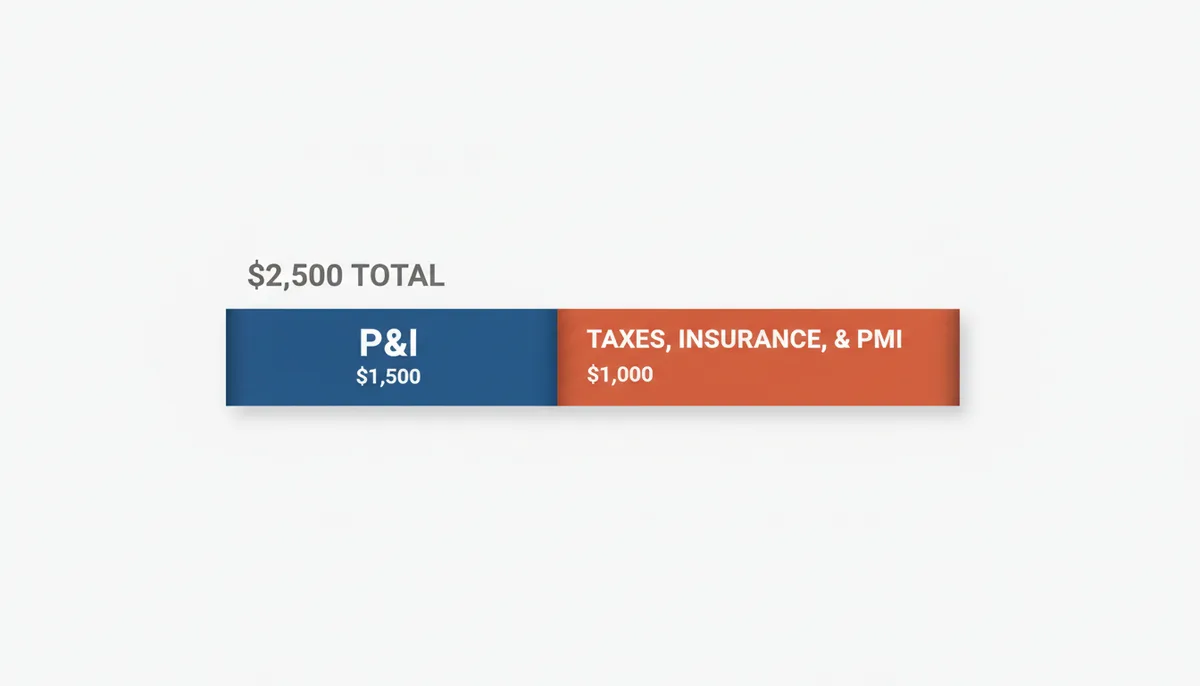
The reason this matters for a reverse calculation: when you start from $2,500 and want to find your home price, you cannot feed $2,500 into a mortgage calculator as the "monthly payment." You have to strip out taxes, insurance, PMI, and HOA first, then solve for the loan using only the P&I remainder. Skip that step and you'll overestimate your price by 20–30%.
Gathering Your Inputs: The Numbers You Need Before You Calculate
You need seven numbers before the reverse calculation works. Four you control. Three you have to research, and getting them wrong is the single biggest source of error in this whole process.
The four you control:
- Target monthly payment. Be honest. Not what you wish you could pay, but what you can pay in month 37 when the furnace dies and you still have groceries. Write the number down. For this walkthrough, we'll use $2,500.
- Down payment in dollars. Not a percentage — a dollar figure you can verify in your savings account. If you have $40,000 liquid after emergency reserves, that's your number.
- Loan term. 30 years is the default for most buyers. A 15-year term roughly doubles your P&I for the same loan size but cuts total interest dramatically. Pick one and stick with it for the calculation; you can re-run with the other later.
- Your credit score band. You don't need the exact score. "740+" gets you the best published rates. "680–739" costs you maybe 0.25–0.50 percentage points. Below 620, conventional financing gets difficult and FHA pricing applies. This determines which rate you plug in.
The three you must research:
Interest rate. Check the current rate for your credit tier and loan type. As of mid-2025, 30-year conventional rates for borrowers with 740+ scores and 20% down have hovered in the 6.0–7.0% range, but this shifts weekly. Pull the number from a lender's rate sheet or a comparison tool the week you run your calculation. Don't use a rate from three months ago. The CalculatorLine.com mortgage calculator lets you enter any rate you choose, so you can test sensitivity without re-doing arithmetic by hand.
Property tax rate. This is the variable people underestimate most. It's expressed as a millage rate or a percentage of assessed value, and it varies by county and municipality. A home in Cook County, Illinois, faces a combined rate above 2%. A home in Hawaii's counties might face under 1%. To find yours: search "[county name] property tax rate" or visit the county assessor's website. Multiply the rate by your target home price to get annual tax, then divide by 12 for monthly. For our example, we'll use 1.25%.
Homeowners insurance premium. Get a quote or two for the area you're shopping. National averages mask huge regional differences — coastal Florida and Texas carry premiums several times what you'd pay in Ohio. For estimation purposes, $100–$200/month is a reasonable bracket for a mid-priced suburban home in most of the country. We'll use $150.
If your down payment is under 20% on a conventional loan, you also need a PMI rate. Lenders quote this as an annual percentage of the loan amount, typically between 0.5% and 1.5% depending on your credit score and LTV (loan-to-value — the loan divided by the home price). A borrower at 760 credit putting 10% down might see 0.55% annually. Someone at 660 putting 5% down might see 1.25%. Divide the annual percentage by 12 and multiply by your loan amount for the monthly figure.
The 'Reverse' Calculation: A Step-by-Step Walkthrough
With your inputs gathered, here's the procedure. I'll walk through it with the $2,500 example at 6.0% interest, 30-year term, 1.25% tax rate, $150 insurance, and a $40,000 down payment.
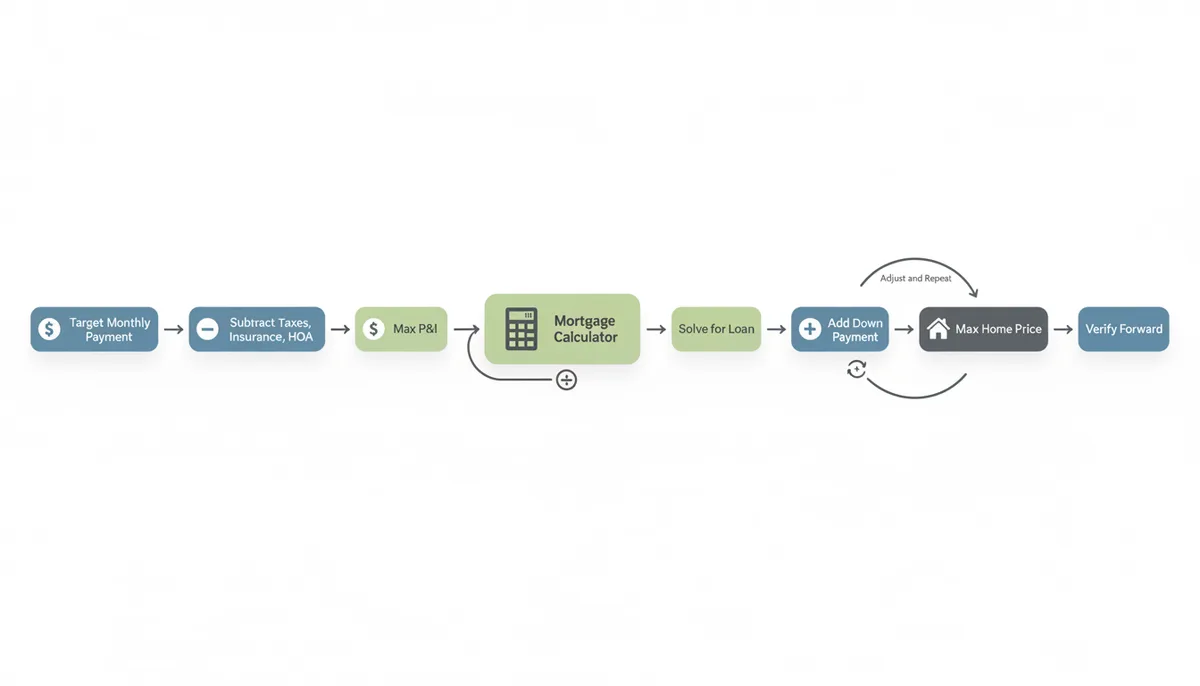
Step 1: Subtract the non-P&I costs from your target payment.
Estimate taxes on a rough home price. Since you don't know the price yet, iterate: guess $350,000, compute tax, refine. For a first pass, assume the home will land somewhere between $300,000 and $450,000. At $380,000 and 1.25%:
- Annual tax: $380,000 × 0.0125 = $4,750 → monthly: $396
- Insurance: $150
- PMI (assuming 10% down, loan ≈ $342,000, rate 0.65%/yr): $342,000 × 0.0065 / 12 = $185
- HOA: $0 (single-family, no association)
Total non-P&I: $396 + $150 + $185 = $731
Available for P&I: $2,500 − $731 = $1,769
Step 2: Solve for the loan amount using P&I, rate, and term.
Feed $1,769 as the monthly payment, 6.0% as the annual rate, and 360 months as the term into a mortgage calculator. On CalculatorLine.com's mortgage calculator, you enter the loan amount to get the payment — so for the reverse, you're solving for the unknown. The payment factor at 6.0% over 30 years is approximately 0.005996 per dollar borrowed. Divide:
Loan amount = $1,769 / 0.005996 ≈ $295,000
Step 3: Add your down payment to get the maximum home price.
Max home price = $295,000 + $40,000 = $335,000
Step 4: Verify by running forward.
Take $335,000, subtract $40,000 down, get a $295,000 loan. Run it through the calculator at 6.0%/30yr: P&I = $1,769. Add tax ($335,000 × 0.0125 / 12 = $349), insurance ($150), PMI ($295,000 × 0.0065 / 12 = $160). Total: $1,769 + $349 + $150 + $160 = $2,428. Under $2,500. Good. You have about $72 of headroom for rate fluctuations or a slightly higher tax bill.
If the forward check overshoots your target, reduce the assumed home price by $5,000–$10,000 and repeat. Two iterations usually converge.
How Your Down Payment Changes Everything
A larger down payment does two things simultaneously: it shrinks the loan (so P&I drops) and it can eliminate PMI entirely once you cross 20% equity. Both effects free up monthly dollars that go toward a bigger loan, which means a bigger house for the same payment.
Look at what happens across four down-payment scenarios, all holding the $2,500 target, 6.0% rate, 30-year term, 1.25% tax, and $150 insurance constant:
| Down Payment % | Down Payment $ | PMI Required? | Max Loan Amount | Max Home Price |
|---|---|---|---|---|
| 3.5% (FHA floor) | $11,000 | Yes — FHA MIP, ~$175/mo | $305,000 | $316,000 |
| 5% | $16,200 | Yes — ~$167/mo | $308,000 | $324,000 |
| 10% | $34,300 | Yes — ~$141/mo | $309,000 | $343,000 |
| 20% | $80,400 | No | $322,000 | $402,000 |
The jump from 10% to 20% down adds roughly $59,000 to the affordable price. That's not a rounding error. It's the difference between a three-bedroom ranch and a four-bedroom colonial in the same school district.
But here's the trade-off nobody puts in the calculator: that extra $46,000 you'd put toward 20% down instead of 10% is $46,000 you no longer hold in liquid savings. Closing costs on a $400,000 purchase run 2–5% of the price ($8,000–$20,000). A new roof might cost $12,000. If you drain your account to avoid PMI, you're one appliance failure away from a credit-card spiral. My position: put down enough to kill PMI if you can do it while keeping at least six months of expenses plus closing costs in reserve. If that math doesn't work, pay the PMI and keep your cushion. PMI on a $309,000 loan at 0.55% is about $141/month — annoying, but recoverable. A blown savings account is not.
Adjusting for 'Hidden Costs' That Wreck Budgets
Property taxes are not a national constant. They are set by county assessors, school districts, municipal bonds, and special districts layered on top of each other. Two homes three miles apart can face tax rates that differ by a full percentage point. At $500,000, that's a $5,000 annual swing — $417/month — which is the entire difference between affording a $500,000 house and not affording it.
HOA fees are even less forgiving. They don't scale with your loan. They don't go away when you pay off the mortgage. A $500/month HOA in a luxury condo tower reduces the dollars available for PITI by exactly $500 every month, permanently. You cannot refinance your way out of an HOA assessment.
Consider two $500,000 purchases, 20% down, 6.0% rate, 30-year term. Same loan, same P&I of $2,398. Different worlds otherwise:
| Location | Property Tax Rate | Monthly Tax | HOA Fee | Monthly Insurance | Total Monthly Payment |
|---|---|---|---|---|---|
| Suburban single-family, County A | 1.25% | $521 | $50 | $130 | $3,099 |
| Urban condo tower, County B | 2.50% | $1,042 | $500 | $180 | $4,120 |
Same sticker price. $1,021 per month apart. Over 30 years, that's $367,000 in additional outflow for the condo buyer — money that never builds equity, never reduces a loan balance. If your ceiling is $3,000/month, the condo is simply not in your range regardless of what the listing price says.
The lesson for your reverse calculation: estimate taxes and HOA for the specific neighborhoods you're targeting, not for the country or even the state. Pull the last two years of tax bills from the county assessor's portal for comparable homes. Ask the HOA management company for the current assessment and any pending special assessments (a roof replacement vote can add $2,000–$5,000 per unit in a single year). Plug those real numbers into Step 1 of the reverse calculation before you ever open a listing site.
Will a Lender Agree? Stress-Testing Your Budget with DTI
You've calculated that $2,500/month buys you a $335,000 home. Beautiful. Now a lender looks at your pay stubs and says no. This happens constantly, and the reason is the debt-to-income ratio.
DTI compares your monthly obligations to your gross (pre-tax) monthly income. There are two flavors:
- Front-end DTI (also called the housing ratio): your total PITI + PMI + HOA divided by gross monthly income. Most conventional lenders want this at or below 28%.
- Back-end DTI (total debt ratio): your housing payment plus every other recurring debt — auto loans, student loans, minimum credit-card payments, child support — divided by gross monthly income. Conventional loans generally cap this at 43–45%. FHA loans can stretch to 50% or slightly above with compensating factors. VA loans have no hard cap but lenders apply their own overlays.
Run your own back-end DTI before you fall in love with a price. Example: gross monthly income $7,200. Housing payment $2,500. Car loan $420. Student loan $310. Credit card minimums $180. Total debt: $3,410. Back-end DTI: $3,410 / $7,200 = 47.4%. That's over the 43% conventional guideline. A lender will either deny the loan, require a larger down payment to reduce the housing component, or ask you to pay off the car loan before closing.
The fix is mechanical, not motivational. Either lower your target payment (which shrinks your home price), eliminate a debt (paying off the $420 car loan drops DTI to 41.5% and frees you up), or increase documented income (a second job, a bonus with two-year history, rental income on a property you already own). The Consumer Financial Protection Bureau's guidance on ability-to-repay requires lenders to verify that you can service the debt, not just that the calculator says you can.
If your DTI is comfortable — say 36% — you have room. If it's at 44%+, your reverse-calculated home price is theoretical. The lender's number, not yours, sets the ceiling. Get a pre-approval before you shop, not after.
From a Single Number to a Smart Shopping Range
A single maximum price is fragile. Rates move 0.25% in a week. Your tax estimate might be 15% off because the assessor hasn't updated the parcel since the last owner renovated. Insurance quotes vary by carrier. If you anchor to one number and the inputs shift, you either overextend or leave money on the table.
Build three scenarios by re-running the reverse calculation with adjusted variables:
Conservative (your floor): Use a rate 0.50% above current quotes. Bump your tax estimate 15% higher than the documented rate. Add $30/month to insurance. Include HOA at the upper end of the range for your target neighborhoods. This gives you a price you can close on even if the market moves against you during the 30–45 days between offer acceptance and funding.
Target (your center): The calculation we walked through in the step-by-step section above. Current rate, best-available tax data from the county assessor, median insurance quote from two carriers.
Reach (your ceiling): Use the lowest rate you qualify for based on your credit tier. Apply the documented tax rate for the cheapest county in your search area. Assume no HOA (single-family only, or a community with minimal fees). This is the absolute top of your search filter, and you should expect to lose a few bidding wars at this level because the margins are thin — any rate bump or tax surprise during underwriting could push the deal out of reach.
For our $2,500 example at 6.0% interest, 1.25% tax rate, $150 insurance, and a $40,000 down payment, here's how the three tiers emerge:
- Conservative: Rate at 6.5%, tax bumped to 1.44% (1.25% × 1.15), insurance at $180. Non-P&I costs rise to roughly $810. Available P&I drops to $1,690. Loan amount falls to about $282,000. Max home price: $282,000 + $40,000 = $322,000. Round down to $305,000 if you want a further safety margin for closing-cost surprises.
- Target: Rate at 6.0%, tax at 1.25%, insurance at $150. Non-P&I costs total $731. Available P&I: $1,769. Loan amount: $295,000. Max home price: $295,000 + $40,000 = $335,000.
- Reach: Rate at 5.75% (best available for 760+ credit), tax at 1.0% (cheaper county), insurance at $130, no PMI (assume 20% down of $80,000 instead). Non-P&I costs: $375 + $130 = $505. Available P&I: $1,995. Loan amount: $333,000. Max home price: $333,000 + $80,000 = $413,000. If you hold the down payment at $40,000 instead, the Reach tier lands near $360,000.
Set your listing alerts to the Reach number. Filter your actual offers to the Target range. Treat anything above Target as a negotiation where you need seller concessions, a locked rate, or a larger down payment to make the math work.
The CalculatorLine.com mortgage calculator handles all three runs in under a minute each — change the rate field, adjust the loan amount, read the payment. No spreadsheet gymnastics. Run it three times, write the three prices on an index card, and hand that card to your agent. It keeps you from drifting upward one "just a little more" at a time.
What If Your Calculated Home Price Seems Too Low?
You did the math. The number is $335,000. You wanted $425,000. The gap feels unfair, and your first instinct is to find a calculator bug. There isn't one. The gap is real, and it comes from taxes, PMI, insurance, and the fact that 6% interest on a 30-year loan means roughly 55% of your early payments go to the bank, not to your equity.
You have four categories of levers. Pull them in this order, because some are cheaper than others:
1. Change the loan parameters. A 15-year term at 6.0% roughly doubles your P&I per dollar borrowed compared to 30-year, but you build equity fast and pay far less total interest. The catch: for the same $2,500 P&I budget, a 15-year loan supports a smaller principal. So this lever helps if your goal is long-term cost, not maximum price today. An adjustable-rate mortgage (ARM) — say a 5/1 or 7/1 — starts 0.5–0.75% below the 30-year fixed rate, which increases your affordable price by $15,000–$25,000. But after the fixed period, the rate resets. Calculate your worst-case payment at the fully-indexed rate plus the cap (often 2% above the initial rate for the first adjustment). If you can't afford that, the ARM isn't a bargain; it's a deferred problem.
2. Change the financial inputs. Increase your down payment. Even moving from 5% to 10% in our table added $19,000 to the price. Pay off the car loan. Negotiate a lower student-loan payment through an income-driven repayment plan. Every $100 you remove from back-end debt frees roughly $100 for housing, which at 6%/30yr supports about $16,700 more in loan principal.
3. Change the location. Property tax is the single largest variable outside your control. Moving from a 2.5% county to a 1.1% county on a $350,000 home saves $490/month in taxes — which, run backward through the calculator, supports roughly $82,000 more in home price for the same total payment. This doesn't mean relocate across the country. It often means the next town over, or the side of a school-district boundary where the millage rate drops.
4. Change the property type. A condo with a $200 HOA and a master insurance policy (you insure the interior only) can have lower total monthly costs than a single-family home with a $500/year lawn service, $1,200/year pest control, and full-structure insurance. The trade-off: you build no land equity, and HOA rules constrain renovations. Run both through the reverse calculation and compare the resulting price ceilings.
None of these levers is magic. Each trades something — liquidity, flexibility, location preference, long-term certainty — for a higher number today. Decide what you're willing to trade before you walk into a showing, not after you've fallen in love with a kitchen.
Frequently Asked Questions
Does my credit score directly affect the home price I can afford?
Not directly, but the effect is substantial. Your credit score doesn't appear in the mortgage formula. What it does is determine the interest rate a lender offers you. A borrower at 760 might get 6.0%; a borrower at 660 might get 6.75% for the same loan product. That 0.75% spread on a $300,000 loan adds roughly $130/month in P&I. Run that backward: $130/month less available for principal means about $22,000 less in affordable home price. So yes — your score shapes the price ceiling, just through the rate channel rather than as a direct input.
How do I estimate property taxes for a specific house I'm interested in?
Three reliable methods, in order of accuracy. First, the county assessor or tax collector's website: search the parcel by address and you'll see the current assessed value, the applicable millage rates, and the prior two years of tax bills. Second, the listing itself: most major platforms display the most recent annual tax amount in the property details. Third, ask your agent for the tax history on comparable homes within a half-mile radius. Avoid using a state or national average — it will be wrong for your specific parcel, sometimes by thousands of dollars annually.
Should I include utilities, maintenance, and repairs in my monthly payment calculation?
Lenders exclude them from DTI, so they won't affect your loan approval. But they absolutely affect whether you can live in the house without going broke. A widely used rule of thumb: budget 1–2% of the purchase price per year for maintenance and repairs. On a $350,000 home, that's $3,500–$7,000 annually, or roughly $300–$580/month. Add utilities ($150–$300 depending on climate and square footage) and you're looking at $450–$880/month in costs the mortgage calculator never shows you. If your $2,500 housing payment leaves you with $400/month for everything else after groceries and transport, the house is too big regardless of what the lender approved.
What's the difference between pre-qualification and pre-approval?
Pre-qualification is a conversation. You tell a lender your income, debts, and approximate credit score; they give you a ballpark borrowing figure. No documents are verified. It's useful for narrowing your search, but it carries zero weight in a competitive offer. Pre-approval is a conditional commitment. You submit W-2s, pay stubs, bank statements, and a hard credit pull. The underwriter reviews them and issues a letter stating a specific loan amount, rate range, and program. Sellers and agents treat pre-approval as evidence you can actually close. For the reverse calculation, pre-approval is the checkpoint: it confirms the rate and DTI assumptions you plugged in are the ones a real lender will honor.
Can I get a mortgage if my DTI is over 43%?
It's possible, but the options narrow quickly. FHA loans can approve borrowers up to 50% DTI (and in rare manual-underwrite cases, slightly higher) if you have compensating factors: a credit score above 700, significant cash reserves (six months of payments post-closing), or a large down payment. Conventional loans above 45% DTI are essentially unavailable through Fannie Mae and Freddie Mac guidelines. VA loans technically have no ceiling, but most lenders overlay a 41–43% cap. If your back-end DTI sits at 46%, the practical path is to eliminate a debt before applying — even a $200/month car payoff can bring you under the threshold and unlock conventional pricing.
How do adjustable-rate mortgages (ARMs) affect this calculation?
An ARM's initial rate is lower than a 30-year fixed, which inflates your affordable price in the reverse calculation. A 5/1 ARM at 5.5% versus a 30-year fixed at 6.5% might add $30,000–$40,000 to your price ceiling. The danger arrives at the first adjustment, when the rate resets to the index plus margin, subject to periodic and lifetime caps. You must run the reverse calculation twice: once at the teaser rate, once at the worst-case rate (initial rate + first adjustment cap, often 2%). If the worst-case payment exceeds your budget, the ARM isn't affordable — it's a bet that rates will fall or you'll sell before the reset. For most buyers staying put beyond five years, the fixed-rate calculation is the one that should set your price range.
Putting It All Together
The reverse calculation isn't complicated arithmetic. It's a sequence of small subtractions and one division, repeated until the numbers agree. What makes it hard is discipline: researching real tax rates instead of guessing, getting actual insurance quotes instead of using a national average, confirming your rate with a lender instead of trusting a headline, and checking your DTI before you tour a single open house.
Do the work once, carefully, and you walk into every showing knowing your ceiling. You stop overbidding on homes that look affordable at the P&I level but choke you at the PITI-plus-HOA level. You stop losing sleep over a number that a calculator spat out without context. And when a seller counters at $352,000 and your conservative tier is $305,000, you can walk away cleanly — or negotiate a credit — instead of stretching into a payment that makes month fourteen miserable.
Start with the payment you can sustain. Subtract the costs nobody puts in the headline. Solve for the loan. Add your down payment. Check your DTI. Build three tiers. Then go look at houses.
Sources
- Consumer Financial Protection Bureau (CFPB) — Definitions and official guidance on PITI, DTI ratios, and consumer rights in the mortgage process.
- U.S. Department of Housing and Urban Development (HUD) — Official rules and guidelines for FHA loans, including minimum down payments, mortgage insurance premium (MIP) requirements, and DTI considerations.
- Freddie Mac — Underwriting standards for conventional mortgages, serving as a primary source for lender requirements on LTV and DTI.
- Internal Revenue Service (IRS) — Official rules regarding the mortgage interest deduction (Publication 936), a secondary financial consideration for some homebuyers.