How to Compare Two Loan Offers with a Loan Calculator
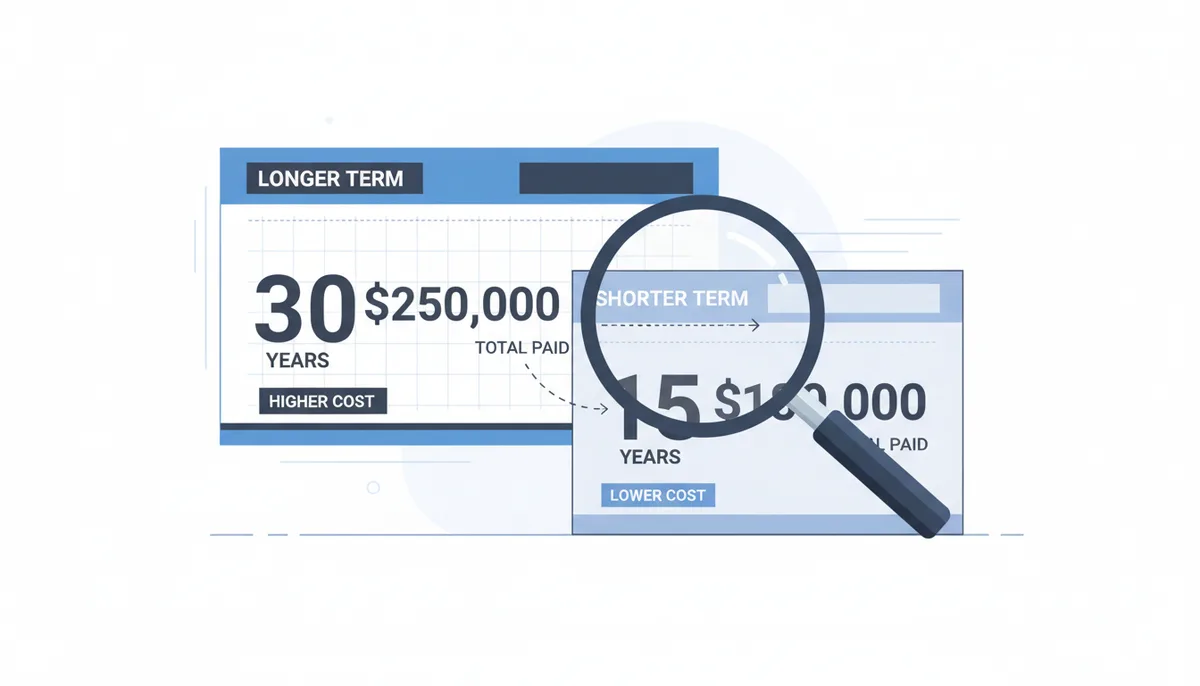
You see two offers for the same car. One lists a payment of $358 a month. The other shows $483. The choice seems obvious until you realize the first stretches seven years and the second lasts five. By the time you own the car outright, you will have paid over a thousand dollars more in interest for the pleasure of that lower monthly bill. Lenders know you look at the payment first. They stretch terms, hide fees in APR spreads, and hope you never calculate the total cost. You need a system that exposes the real price of borrowing, not just the monthly pressure on your wallet.
Why You Can't Judge a Loan by Its Monthly Payment
The monthly payment is a cash-flow measurement. It tells you whether you can afford the loan this month. It tells you nothing about how much you will bleed in interest over the life of the debt. Lenders exploit this blind spot by extending terms.
A $25,000 auto loan at 6% interest costs $483 monthly over five years, totaling about $29,000. Stretch that same loan to seven years and the payment drops to $365, but the total cost climbs to roughly $30,700. You pay about $1,700 extra for the exact same car.
The advertised interest rate is the next trap. A lender might offer 6.5% on paper but charge $5,000 in origination fees and points. Another lender offers 6.8% with zero fees. The first looks cheaper until you realize the fees push the real cost higher than the second option. This is why the Annual Percentage Rate (APR) exists. It rolls the interest rate and most upfront fees into a single annual percentage.
If two loans have identical terms, the one with the lower APR is almost always the cheaper loan. But APR is still a snapshot. It assumes you keep the loan for the full term and pay exactly as scheduled. It does not account for prepayment penalties, variable-rate risks, or your personal timeline for debt freedom. You need to dig deeper.
Assembling Your 'Loan Comparison Kit': What to Gather First
Before you touch a calculator, get every offer in writing. The document you demand depends on the loan. For a mortgage, insist on the official Loan Estimate—a standardized three-page form the Truth in Lending Act requires lenders to give you within three business days of your application. For an auto loan or a personal loan, there is no Loan Estimate; instead, ask for the lender's written offer or Truth in Lending disclosure, which must state the amount financed, the APR, the total finance charge, the term, and the payment schedule. Do not rely on promotional flyers, emails, or verbal quotes. Those numbers change between the sales pitch and the signing table.
From each written disclosure, extract these specific figures:
- Loan Amount: The actual cash you receive (on a mortgage, the amount financed after your down payment). On a car purchase, this might differ from the sticker price due to down payments, trade-ins, or dealer add-ons.
- Interest Rate: The nominal rate used to calculate your monthly payment. This is not the APR.
- Rate Type: Whether the rate is fixed or variable—and, if variable, when and how far it can adjust.
- Loan Term: The number of months until the debt is scheduled to retire.
- Origination Fees: The flat fees or percentage the lender charges for processing the loan.
- Points (mortgages only): Prepaid interest you can buy to lower the rate. One point equals 1% of the loan amount.
- Other Fees: Appraisal fees, title insurance, credit report fees, dealer documentation fees, and any mandatory third-party charges the lender requires.
- Prepayment Terms: Whether the lender charges a penalty if you pay the loan off early.
Write these numbers down or paste them into a spreadsheet. Using inconsistent data—comparing one lender's casual pre-qualification guess against another's formal written disclosure—will lead you to the wrong decision. Verify that every figure comes from an official document dated within the same week. Rates change daily, and stale quotes are lies.
Step 1: Calculate the Total Cost of Each Loan
Open a loan calculator. You can find one on CalculatorLine.com or any financial site, but ensure it outputs an amortization schedule and a total interest figure. You are going to run this calculation once for each offer.
Enter the Loan Amount exactly as it appears on the Loan Estimate. Do not round. Enter the Interest Rate as the nominal rate, not the APR. Set the Loan Term to the exact number of months. Click calculate.
The calculator will return three critical numbers. The Monthly Payment confirms the lender's math. The Total Interest Paid shows how much pure cost you will incur for borrowing. The Total Payments (or Total Cost) adds the principal and interest together. This last number is your baseline for comparison. It represents the lifetime cost of the loan before you factor in upfront fees.
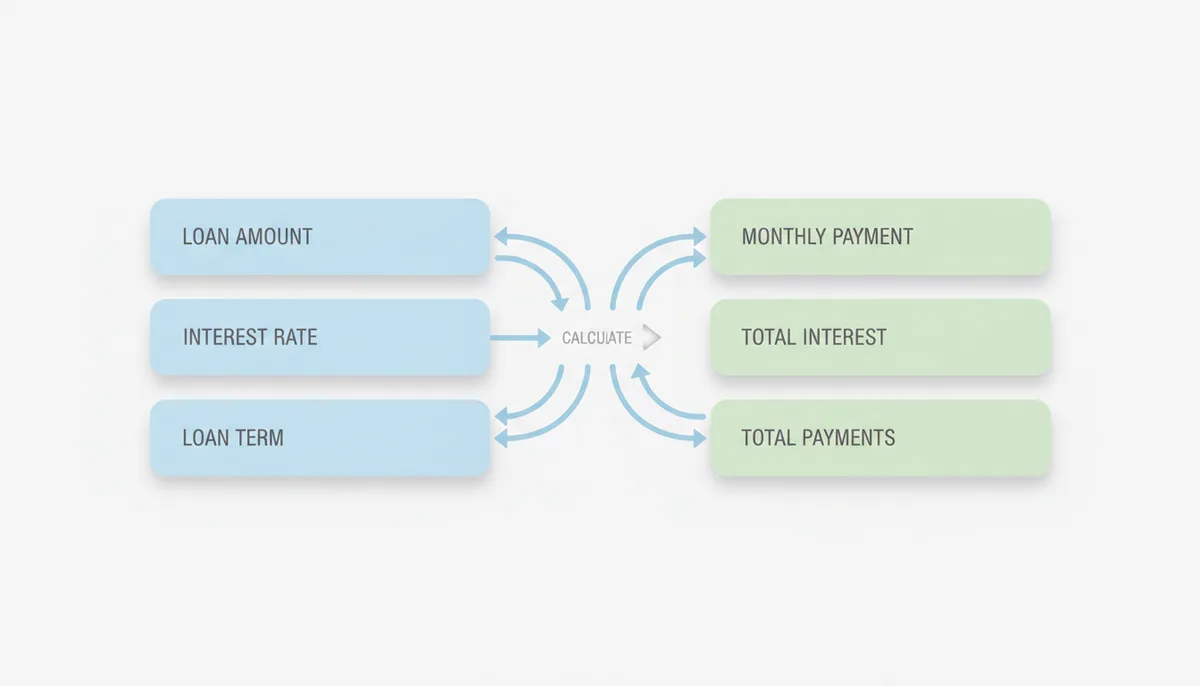
Record the Total Payments for Loan A. Change the inputs to match Loan B. Record that number. If the two loans have identical terms and no fees, the one with the lower Total Payments wins. But they almost never have identical fees, which brings you to the next step.
Step 2: How to Factor in Fees and Understand the True APR
APR is the interest rate plus the lender's fees, expressed as an annual rate. Think of it as the true price per year for the money you are borrowing. When two loans share the same term and loan amount, the APR is the single best metric for direct cost comparison. It cuts through camouflage.
High upfront fees destroy the value of a low advertised rate. Consider two competing offers for a $250,000 mortgage over 30 years:
| Offer | Advertised Rate | Origination Fee | APR | Monthly Payment | Total Cost |
|---|---|---|---|---|---|
| Loan A | 6.8% | $10,000 | 7.12% | $1,630 | $596,800 |
| Loan B | 6.9% | $0 | 6.90% | $1,645 | $592,200 |
Loan A looks cheaper on the rate. It even has a lower monthly payment. But the $10,000 fee pushes its APR and total lifetime cost above Loan B. Over thirty years, Loan B saves you $4,600 despite charging a higher monthly bill. This is why you never compare advertised rates alone. Always calculate the APR impact or rely on the APR figure printed on page one of the Loan Estimate.
Step 3: Compare Amortization Schedules to See Where Your Money Goes
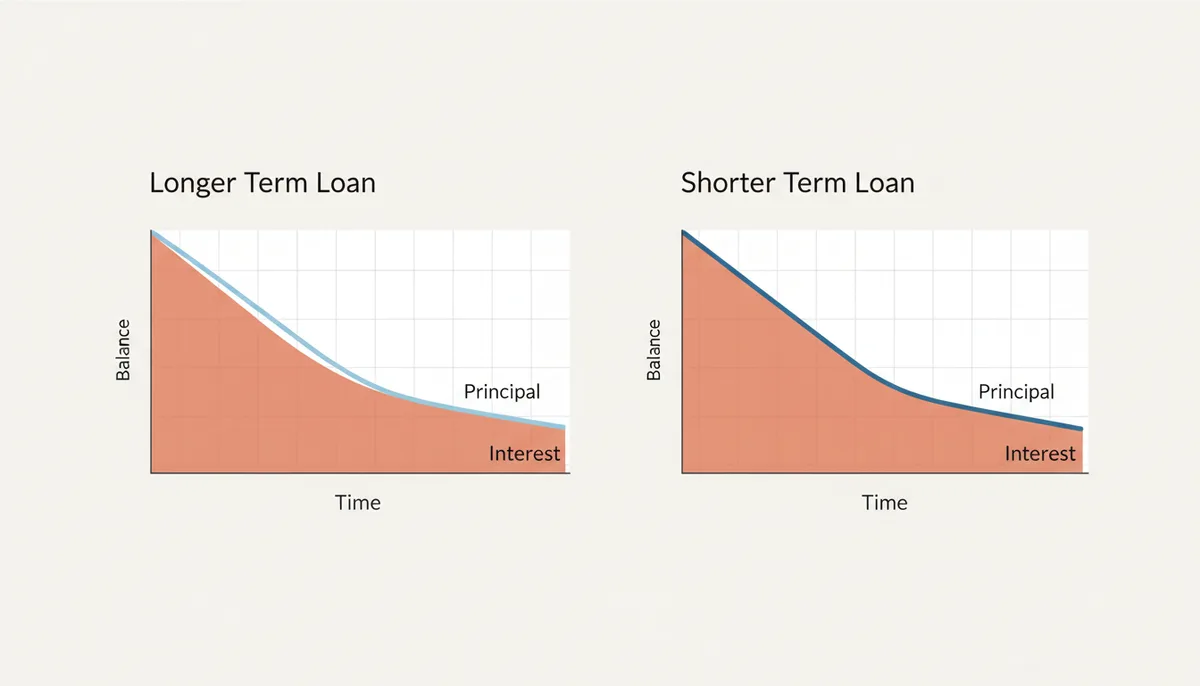
An amortization schedule is a month-by-month ledger of your debt. It shows exactly how much of each payment covers interest and how much reduces the principal. In the early years, you are paying almost pure interest. On a 30-year mortgage, you do not pay off half the principal until roughly year twenty-one. This matters if you plan to sell the house, refinance, or pay ahead.
Generate the schedule in your calculator for both loans. Look at the first five years. How much principal have you actually paid off? On a $250,000 loan at 7%, five years of payments totals roughly $120,000, but you have only reduced the principal by $25,000. The other $95,000 vanished into interest. If you sell the house in year six, you walk away with far less equity than you might expect.
Now compare a 15-year loan at the same rate. The monthly payment is higher—roughly $2,247 versus $1,663—but after five years you have paid down $76,000 in principal. You own substantially more of the asset, and if you sell, you keep more cash. When comparing two amortization schedules, look for the crossover point where the principal portion of the payment exceeds the interest portion. The earlier that happens, the faster you build equity.
If you suspect you will move or refinance within five years, prioritize the loan that pays down principal faster, even if the APR is slightly higher. You will recover more at closing.
What If the Loan Terms Aren't Identical?
You rarely compare two loans with identical terms. One auto lender offers 48 months; another pushes 72. One mortgage broker quotes 15 years; a bank suggests 30. You cannot compare APRs across different terms. A 15-year loan will almost always have a lower APR than a 30-year loan because the lender gets their money back faster with less risk, but the monthly payment is brutal.
You face a fundamental trade-off. A longer term lowers your monthly payment, improving your cash flow and keeping your debt-to-income ratio healthy. It also maximizes the total interest you pay. A shorter term minimizes lifetime cost but strains your monthly budget.
Look at the hard numbers for a $25,000 auto loan at 7% APR:
| Term (months) | Monthly Payment | Total Interest Paid | Total Cost |
|---|---|---|---|
| 36 | $778 | $3,008 | $28,008 |
| 48 | $601 | $3,848 | $28,848 |
| 60 | $495 | $4,700 | $29,700 |
| 72 | $425 | $5,600 | $30,600 |
Stretching from three years to six years cuts your monthly bill by $353 but costs you $2,592 in extra interest. That is more than 10% of the car's price paid simply for the luxury of smaller installments.
Choose the shorter term you can afford without dipping into emergency savings. If the 36-month payment leaves you with less than three months of expenses in the bank, take the 48-month option. Liquidity prevents default. But do not take the 72-month loan just to free up cash for discretionary spending. You are buying a depreciating asset with borrowed money; minimize the duration of that mistake.
Beyond the Numbers: Evaluating Qualitative Loan Features
A loan is a contract, not just a math problem. Buried in the fine print are clauses that can cost you thousands even if the APR looks perfect.
Prepayment penalties are the most dangerous. Some lenders charge you a percentage of the remaining balance or several months of interest if you pay off the loan early. If you plan to refinance when rates drop, sell the house, or use a bonus to clear your debt, a prepayment penalty destroys your flexibility. Check the Loan Estimate under "Prepayment Penalty." If it says "Yes," demand to know the exact calculation. If the lender will not remove it, walk away unless the APR is significantly lower than any alternative—usually by more than 0.5%—to compensate for the risk.
Fixed versus variable rates present another trap. A variable-rate loan might start at 5%, two points below the fixed option. It feels like a bargain. But if rates rise, your payment climbs. On a $300,000 mortgage, a 2% rate increase adds roughly $400 to your monthly bill. If you cannot absorb that spike, you are gambling with your home. Take the fixed rate unless you know you will sell or pay off the loan before the adjustment period hits—typically three to seven years.
Finally, consider the lender's operational competence. A cheap loan from a bank that loses paperwork, misses closing dates, or lacks online payment portals can cost you in stress and late fees. Read recent reviews about the specific branch or loan officer handling your file, not just the parent institution's brand.
Common Mistakes When Comparing Loans (And How to Avoid Them)
Even with a calculator, borrowers routinely sabotage their own comparisons.
Mistake: Comparing Interest Rates Instead of APR. The interest rate determines your monthly payment. The APR determines your total cost. A loan with a lower rate but high fees can cost more than a loan with a higher rate and zero fees. Always use APR for same-term comparisons.
Mistake: Ignoring the Amortization Timeline. If you plan to move or refinance in five years, you care about how much principal you have paid off in those five years, not the total cost over thirty. A 30-year loan with a slightly lower APR might leave you with less equity than a 20-year loan when you sell, costing you money at closing.
Mistake: Comparing Pre-Qualification to a Loan Estimate. A pre-qualification is a guess based on self-reported income. A Loan Estimate is a binding offer based on verified data. Comparing a pre-qualification from Lender A to a Loan Estimate from Lender B is like comparing a Zestimate to an appraisal. They are not the same thing.
Mistake: Forgetting Prepayment Penalties. If you intend to pay off the loan early—whether through a windfall, a refinance, or a sale—failing to check for prepayment penalties can lock you into expensive debt. Always verify this field on the Loan Estimate.
Mistake: Normalizing Inputs to "Match." Do not change the loan amount or term in the calculator to make two offers comparable. If Lender A offers $240,000 over 30 years and Lender B offers $245,000 over 15 years, calculate each as written. Changing the inputs obscures the real trade-offs. A 15-year loan forces a higher monthly payment for lower total cost. That is the decision you are making. Do not hide it with false symmetry.
Putting It All Together: A Final Decision Checklist
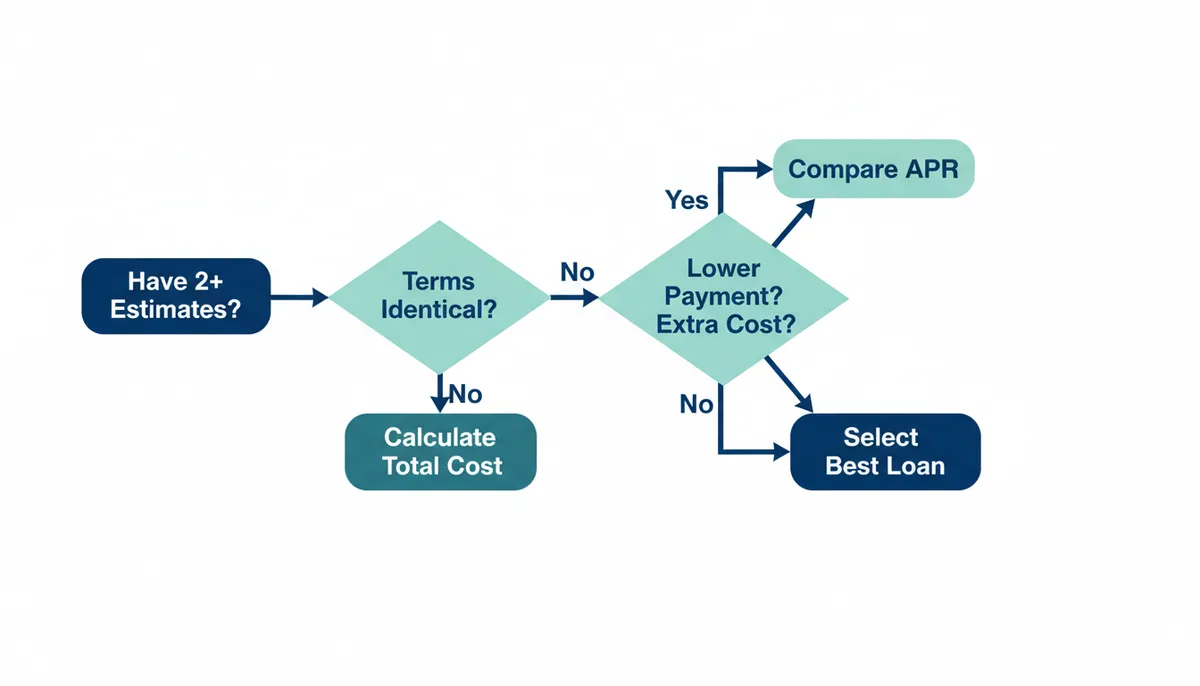
You have the Loan Estimates. You have the calculator. Work through this sequence before you sign anything.
- Gather Official Loan Estimates: Ensure every offer is a standardized, dated Loan Estimate, not a pre-qualification or advertisement.
- Compare APRs for Same-Term Loans: If the loan amount and term are identical, choose the loan with the lower APR. It is mathematically the cheaper option.
- Calculate Total Cost for Different-Term Loans: If the terms differ, run the full amortization for each. Compare the Total Payments plus any upfront fees. Decide whether the lower monthly payment of the longer term is worth the extra total cost.
- Review Amortization Schedules for Equity-Building Speed: If you might sell or refinance early, choose the loan that pays down principal faster in the first five years, even if the total cost is slightly higher.
- Check for Prepayment Penalties: Reject any loan with a prepayment penalty unless the APR is at least 0.5% lower than the best alternative.
- Assess Qualitative Factors: Verify the rate is fixed if you cannot handle payment increases. Research the lender's reputation for closing on time.
This process takes thirty minutes and saves you thousands. Do not skip steps because a lender pressures you to "lock in today." The rate market moves, but your financial obligation lasts for years.
How to Stress-Test Variable-Rate Offers Against Fixed-Rate Alternatives
You see the 5/1 ARM quoted at 5.5% and the 30-year fixed at 7.2%. On a $400,000 loan, that gap saves you $445 a month—over $26,000 in the first five years. Lenders present this as a discount. It is actually a leveraged bet on interest rates, and you need to model the worst-case scenario before you compare it to the fixed option.
Start by finding the loan’s adjustment caps. Every adjustable-rate mortgage discloses three limits: the initial cap (how far the rate can jump after the fixed period ends), the periodic cap (the annual increase limit thereafter), and the lifetime cap (the absolute ceiling). A common structure is 2/2/5. After five years, the rate can surge 2% in one month. Then it can climb 2% per year until it hits 5% above your starting rate—10.5% total in this example.
Now calculate the cumulative cost at three distinct horizons: the break-even point, the medium term, and the long haul. For the first five years, the ARM costs $2,271 monthly. In year six, assuming the worst initial adjustment, it jumps to 7.5%—roughly $2,797. By year eight, it hits the 10.5% ceiling, ballooning the payment to $3,410.
| Scenario | Years 1-5 Monthly | Years 6-7 Monthly | Years 8-30 Monthly | Total Cost if Sold Year 5 | Total Cost if Kept 30 Years |
|---|---|---|---|---|---|
| 5/1 ARM (5.5% start, 2/2/5 caps) | $2,271 | $2,797 | $3,410 | $136,260 + $371,000 principal = $507,260 | $1,148,000 |
| 30-Year Fixed (7.2%) | $2,716 | $2,716 | $2,716 | $162,960 + $373,000 principal = $535,960 | $977,760 |
If you sell in year five, the ARM saves you $28,700 even in the worst case. But if you keep the loan for the full term and rates rise to the caps, the ARM costs you $170,000 more than the fixed option. The decision hinges on your time horizon and your capacity to absorb payment shock. Take the ARM only if you are certain you will sell or refinance before year seven, and only if you could afford the $3,410 payment if trapped. Otherwise, the fixed rate is insurance, not a premium.
The Bi-Weekly Payment Workaround: Calculating the Hybrid Approach
You want the $272,000 interest savings of a 15-year mortgage, but the $3,146 monthly payment on a $350,000 loan at 7% leaves you with no emergency cushion. A third path exists between the 30-year albatross and the 15-year straitjacket: keep the 30-year loan for cash flow safety, but pay half the monthly amount every two weeks. This creates 26 half-payments—equivalent to 13 full months per year—shaving roughly five years off the term while preserving the flexibility to drop to the minimum required payment during a crisis.
Run the numbers. A standard 30-year schedule costs $2,329 monthly and $838,440 total. The 15-year demands $3,146 monthly—$817 more—but drops the total cost to $566,280. The bi-weekly strategy splits the $2,329 into $1,165 payments every two weeks. You pay $30,277 annually instead of $27,948, an extra $2,329 per year—the equivalent of one extra monthly payment.
| Strategy | Effective Monthly Outflow | Required Minimum Payment | Total Interest Paid | Loan Paid Off | Flexibility |
|---|---|---|---|---|---|
| 30-Year Standard | $2,329 | $2,329 | $488,440 | 30 years | None |
| 15-Year Fixed | $3,146 | $3,146 | $216,280 | 15 years | Low |
| 30-Year Bi-Weekly | $2,523 | $2,329 | $362,000 | 24.5 years | High |
The bi-weekly route costs $126,000 more in interest than the 15-year loan, but it saves $126,000 over the standard 30-year schedule. Crucially, if you lose your job in month six, you can revert to the $2,329 minimum without calling the bank or risking default. The 15-year loan offers no such downgrade. Use this strategy when your income is variable or your emergency fund covers less than six months. If your income is rock-solid, skip the workaround and take the 15-year term to maximize savings.
The Refinancing Trap: When a Lower Rate Costs More
You have paid eight years on your current 30-year mortgage. You owe $320,000 at 6.5%. A new lender offers 5.8% with $4,000 in closing costs, dropping your payment by $140. You refinance. You have just triggered the amortization restart trap. By resetting to a new 30-year term, you traded 22 remaining years of payments for 30 fresh years of front-loaded interest, adding $150,000 to your lifetime housing cost despite the lower rate.
Compare offers correctly by calculating the total cost to finish your current loan versus the total cost of the new one. Your existing loan requires 22 more years at $2,022 monthly—$533,808 total, with $213,808 in remaining interest. The new loan for $324,000 (including rolled-in fees) at 5.8% for 30 years costs $684,720 total. Even with the rate drop, you pay $150,912 more because you added eight years.
To make the comparison fair, you must match the terms. Calculate what the new rate would cost over your remaining 22 years. A $324,000 loan at 5.8% for 22 years requires a $1,985 payment—only $37 less than your current loan, not the $140 advertised. With the $4,000 fee, you would need 108 months to break even on the savings, longer than most people keep a refinance.
| Scenario | Monthly Payment | Years of Payments | Total Remaining Cost | Principal Paid in 5 Years |
|---|---|---|---|---|
| Keep Current Loan (6.5%, 22yr left) | $2,022 | 22 | $533,808 | $45,000 |
| Refinance to New 30yr @ 5.8% | $1,882 | 30 | $677,520 (first 22 years) | $38,000 |
| Refinance to Matched 22yr @ 5.8% | $1,985 | 22 | $523,560 | $48,000 |
The table reveals the trap. Extending the term to 30 years "saves" you $140 monthly but costs you $143,712 extra over the next 22 years compared to keeping the old loan, and you build $7,000 less equity in the first five years. Only the matched 22-year term saves money—about $10,000—but it offers minimal monthly relief. When comparing a new offer against your existing loan, refuse any term longer than your remaining balance. If the lender will not quote a custom term, use the calculator to find the payment that pays off the new loan in exactly 22 years. If you cannot afford that payment, the refinance is a trap disguised as savings.
Frequently Asked Questions
What's the difference between a Loan Estimate and a Closing Disclosure?
The Loan Estimate is the lender's binding offer, which you use for comparison shopping. It arrives within three days of your application. The Closing Disclosure is the final confirmation of all terms and costs that you receive at least three days before you sign. Compare both documents line by line. If the APR or monthly payment on the Closing Disclosure differs from the Loan Estimate, demand an explanation. Something changed, and it likely was not in your favor.
Can I negotiate the terms of a loan offer?
Yes. You can negotiate the interest rate, especially if you have a competing Loan Estimate with a lower APR. You can often negotiate origination fees or ask the lender to waive specific processing charges. Lenders expect some haggling. If you have excellent credit and a solid down payment, you have leverage. Ask specifically: "Can you match Lender B's APR, or can you reduce the origination fee to zero?" The worst they can say is no.
Does applying for multiple loans hurt my credit score?
For mortgages, auto loans, and student loans, credit scoring models treat multiple inquiries within a short period—typically 14 to 45 days—as a single inquiry. This allows you to shop for the best rate without significant damage to your score. Personal loans do not receive this same protection; each application may ding your score slightly. Submit all your mortgage or auto applications within a two-week window to minimize impact.
Is it better to take a lower interest rate or a cash rebate on an auto loan?
You must calculate both scenarios. Run the loan calculator with the lower interest rate to find the total cost. Then, calculate the total cost using the standard rate but subtract the rebate from the principal loan amount. Choose the option with the lower total outlay. If you plan to pay off the loan extremely early, the rebate is often better because you pay less interest anyway. If you take the full term, the lower rate usually wins.
What is a prepayment penalty?
A prepayment penalty is a fee some lenders charge if you pay off your loan early, either through a lump sum or a refinance. It is usually a percentage of the remaining balance or a set number of months of interest. It is crucial to know if your loan has one, especially if you plan to sell the asset, refinance when rates drop, or use a windfall to clear the debt. Check the Loan Estimate under the "Prepayment Penalty" section.
Why is the APR on my Loan Estimate different from the interest rate?
The interest rate, sometimes called the note rate, is just the cost of borrowing the principal, used to calculate your monthly payment. The APR includes the interest rate plus most upfront fees—like origination fees, points, and certain closing costs—rolled into a single annual percentage. This makes APR a more accurate measure of the loan's true cost. If there is a large gap between the interest rate and the APR, you are paying high fees.
Sources
- Consumer Financial Protection Bureau (CFPB) — Official definitions and explanations of the Loan Estimate form, Closing Disclosure, APR, and consumer rights under the Truth in Lending Act (TILA).