How Your Loan Term Changes Your Monthly Payment and Total Interest
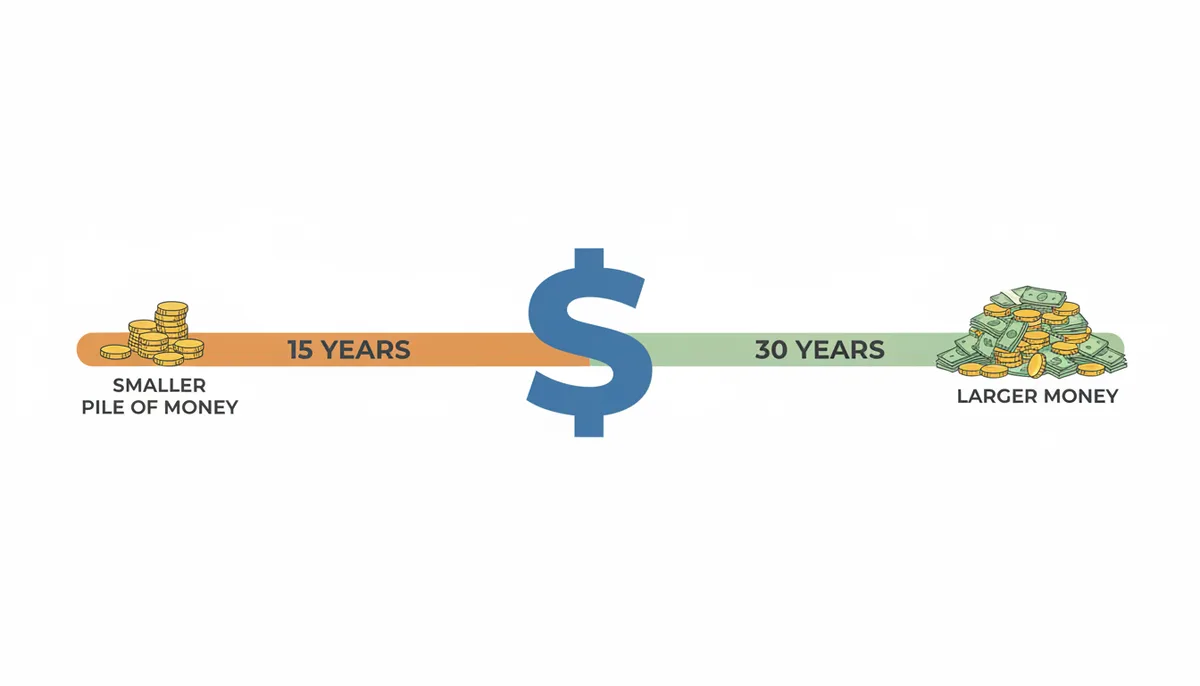
Borrow $300,000 at 6% and you face a choice that will move more money than most salary negotiations: repay over 15 years at $2,532 a month, or over 30 years at $1,799. The 30-year option feels safer. It also costs about $347,500 in interest — roughly $192,000 more than the 15-year version of the same loan at the same rate.
Nobody at the closing table is likely to walk you through that gap, because loans get sold one monthly payment at a time. This guide does the opposite. You'll see exactly why the trade-off exists, how to read the schedule that governs it, and how to run the comparison on your own loan offer in a couple of minutes. You'll also see the situations where the longer, more expensive term is genuinely the right call — and how to shrink a long loan's cost without committing to a payment you can't always make.
Everything below uses real numbers, and none of it requires a finance background. By the end you'll be able to take any loan offer, run two or three scenarios through a free calculator, and see — in dollars, not feelings — what each term actually costs you.
Why Does a Longer Loan Have Lower Payments but Cost More?
Take the same $300,000 and stretch repayment from 15 years to 30, and two separate things happen at once.
First, the principal — the money you actually borrowed — gets sliced into 360 pieces instead of 180. Smaller slices, smaller payment. That part is obvious. The part people underestimate is the second effect: interest.
Interest is rent on money. Every month, the lender charges you a fee equal to your annual rate divided by twelve, multiplied by whatever you still owe. On a 6% loan, that's 0.5% of the outstanding balance, every single month. Owe $300,000 and the month's rent is $1,500. Owe $150,000 and it's $750. The fee doesn't care what your payment is or how long you've had the loan — it only cares how much of the lender's money you're currently holding.
That's where the term bites. A 30-year loan keeps you holding a large balance for a very long time, and every extra month of holding is another rent check. Think of it like renting a concrete mixer: the daily rate might be $60 while the monthly rate works out far cheaper per day — but if you only needed the mixer for a weekend, the "bargain" monthly deal just cost you hundreds more than two day-rentals would have. A 30-year term is the cheap monthly rate on money, and the extra $192,000 is what you pay for keeping the lender's cash two decades longer than the 15-year borrower does.
How much does the term matter relative to everything else? More than the rate, in most real comparisons. Cutting that $300,000, 30-year loan from 6% to 5.75% saves about $17,000 over the life of the loan. Cutting the term from 30 years to 15 saves about $192,000. Term is the biggest cost lever you control at signing — and pulling it costs nothing, because a shorter term isn't a product you buy. It's a schedule you choose.
One assumption runs through everything in this guide: a fixed-rate loan, where the rate never changes. An adjustable-rate mortgage adds a second variable — the rate itself can move — but the term mechanics underneath are identical.
The Anatomy of a Loan Payment: Principal vs. Interest
Open any loan statement and you'll find your payment split into buckets. The two that matter here are principal and interest — together called P&I. Principal is the money you borrowed, coming back home. Interest is the lender's fee for letting you use it. On a mortgage statement you'll usually also see escrow — property tax and insurance the lender collects and passes along. That's real money out of your pocket, but it isn't part of the loan math, so everything below ignores it.
Here's the part that surprises people the first time they see it. On the $300,000, 30-year loan at 6%, the very first payment of $1,799 breaks down like this:
- Interest: $1,500 — that's $300,000 × 0.5%
- Principal: about $299 — everything left over
Roughly 83 cents of your first dollar is pure fee. And it barely improves at first: payment two splits $1,498.51 to interest and $300.14 to principal. You've moved the needle by a dollar and forty-nine cents.
This isn't front-loading or a trick, though it gets called both. It's just the rent formula applied to the biggest balance you'll ever owe. Interest for any month is always rate × current balance, and the balance is never larger than on day one. As payments chip the balance down, the rent shrinks and a bigger share of the same fixed payment flows toward principal.
The shift is slow on a long loan. On the 30-year term, more of each payment goes to interest than principal until roughly 18 and a half years in — nearly two decades of paying before the majority of your money starts building ownership. On the 15-year version of the same loan, that crossover arrives around three and a half years.
If this feels rigged against you, remember it cuts both ways. The same math is why extra payments toward principal — covered later in this guide — punch so far above their weight, and why short loans build equity so quickly once the rent share collapses.
Visualizing the Trade-Off: How an Amortization Schedule Works
Lenders don't mail you this document, but any decent loan calculator generates it in seconds: the amortization schedule, a table with one row per payment for the entire life of the loan. Each row shows the payment number, how much goes to interest, how much goes to principal, and the balance remaining afterward. It's the whole loan written out in advance, with no surprises left in it.
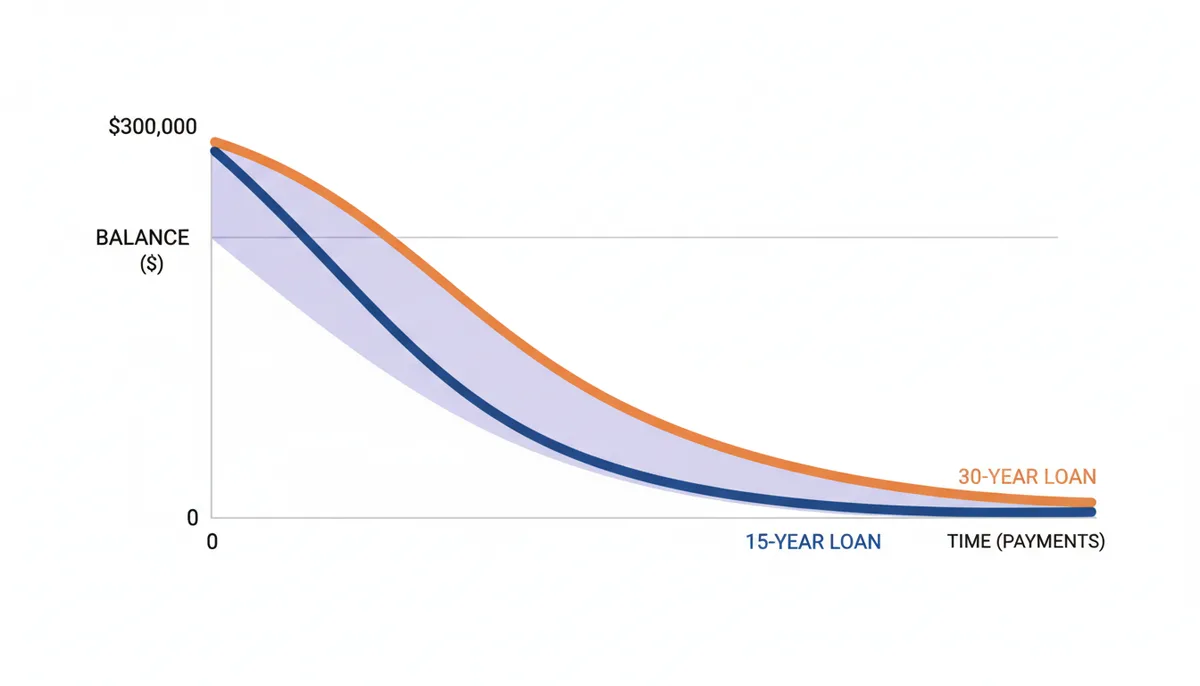
Read a few rows of the 30-year schedule and the trade-off stops being abstract. Payment one: $1,500 of rent, $299 of progress. Scroll to payment 60 — five years of on-time checks, roughly $108,000 out the door — and the balance has fallen from $300,000 to about $279,000. You've reduced your debt by $21,000. The other $87,000 was rent.
Now look at the same row on the 15-year schedule. After 60 payments, the balance sits near $228,000 — about $72,000 of debt gone. The 15-year borrower paid more each month ($2,532 versus $1,799), but the gap in progress dwarfs the gap in payment, because so much less of every check went to rent.
That's the picture worth holding onto: two curves, one diving steeply, one sagging gently for decades. Since interest is charged on the balance, a high, slow-curving balance is exactly what generates an extra $192,000 of cost. Total interest is, roughly speaking, the area trapped under that curve — which is why stretching time inflates cost so violently.
The schedule is also the document to check if you might sell or refinance before the term ends. Whatever the balance column says in the month you exit is what you still owe, and on a 30-year schedule that number stays stubbornly high for years. You don't need to memorize any of this — you need to know the schedule exists, that it exposes the true cost of any term in a single column, and that you should look at it before you choose, not after.
How to Calculate the Impact of Different Loan Terms
You can run this comparison yourself in about two minutes, and you should do it before you sign anything — not after the first statement arrives. Here's the process, using the loan calculator on CalculatorLine (the mortgage calculator works the same way and adds the full amortization schedule):
- Run the base scenario. Enter the loan amount ($300,000), the interest rate from your quote (6%), and the longer term (30 years). Write down three outputs: the monthly payment, the total interest paid, and the total cost of the loan. Use the note rate from your quote for payment math, not the APR — APR folds in fees and will slightly overstate the payment. (APR is the right tool for comparing two lenders against each other; the FAQ at the end covers the difference.)
- Change only the term. Same amount, same rate, 15 years. Record the same three outputs. Holding everything else constant is what isolates the term's effect — and it's the comparison lenders rarely show you side by side.
- Repeat with real quotes. Lenders almost always price 15-year mortgages lower than 30-year ones, so get the actual rate for each term and run both scenarios again with the real numbers.
- Stress-test the bigger payment. Ask whether you could still make it if your household lost one income for three months. If the honest answer is no, that fact matters more than any interest savings.
Here's what the base comparison looks like for the example loan, plus a third row showing a realistic rate discount on the shorter term:
| Loan term | Monthly payment (P&I) | Total interest paid | Total cost of loan |
|---|---|---|---|
| 30 years at 6% | $1,799 | $347,514 | $647,514 |
| 15 years at 6% | $2,532 | $155,684 | $455,684 |
| 15 years at 5.5% | $2,451 | $141,198 | $441,198 |
Principal and interest only — taxes, insurance, and any lender fees are excluded.
Two things jump out of that table. The monthly gap between the two 6% scenarios — about $733 — is far smaller than most people expect, while the interest gap is far larger. And the third row shows why real quotes matter: because shorter terms usually earn a rate discount, the true monthly penalty for going 15-year is often smaller (about $652 here) and the interest savings even bigger (roughly $206,000).
While you're in the calculator, notice the pattern one more time: the payment differences between terms live in the hundreds, but the interest differences live in the hundreds of thousands. Sellers of loans — mortgage brokers, car dealers, furniture stores — negotiate against the small number because it fits inside your monthly budget. Your job is to keep your eyes on the big one.
Beyond Mortgages: How Term Affects Auto, Personal, and Student Loans
Car salespeople negotiate in monthly payments for a reason: stretching the term makes almost any car look "affordable," and the extra interest stays invisible unless you go looking for it. Take a $35,000 car loan at 8%. Over 48 months the payment is about $854 and total interest roughly $6,000. Over 72 months the payment drops to about $614 — but total interest climbs to roughly $9,200. You saved $240 a month and paid about $3,200 for the privilege.
With cars there's a second, sharper risk. New vehicles lose value fastest in the first few years — often around a fifth in year one — while a long loan's balance shrinks slowest in exactly that window (early payments are mostly interest, as you saw above). The result is negative equity, or being "underwater": you owe more than the car is worth. If the car is totaled or stolen during that period, the insurer pays the car's value and you cover the shortfall out of pocket — which is the entire reason GAP insurance exists. My rule of thumb: if a car needs a 72- or 84-month term to fit your budget, the car doesn't fit your budget.
Personal loans compress the same math into smaller numbers with higher rates, since there's no collateral backing them. Borrow $15,000 at 12%: over three years the payment is about $498 and interest roughly $2,950; over five years the payment falls to about $334 but interest rises to roughly $5,020 — a jump of about 70%. On an unsecured loan at a double-digit rate, term length is not a footnote.
Federal student loans play by different rules. The standard repayment plan runs 10 years; income-driven plans stretch to 20 or 25 and then forgive whatever balance remains. A $30,000 loan at 6.5% costs about $341 a month and roughly $10,900 of interest on the standard plan; spread over 25 years the payment drops near $203, but total interest would approach $31,000 — except that the remaining balance may be forgiven, which flips the logic entirely. If you realistically expect forgiveness, a longer term with smaller payments can be the rational choice, and paying extra just shrinks the amount that gets wiped out. The tax treatment of forgiven balances has shifted in recent years, so check the current rules before counting on them.
| Loan type | Typical term lengths | Key term-related consideration |
|---|---|---|
| Mortgage | 10, 15, 20, or 30 years | At 6%, a 30-year term costs more than double the total interest of a 15-year term on the same balance. |
| Auto loan | 36 to 84 months | Terms past 60 months usually mean years of negative equity, because the car depreciates faster than the loan balance falls. |
| Personal loan | 2 to 7 years | Higher unsecured rates amplify the term effect — stretching $15,000 at 12% from 3 years to 5 raises total interest by about 70%. |
| Federal student loan | 10 years standard; 20–25 years on income-driven plans | Long terms pair with forgiveness of the remaining balance, which can make minimizing the monthly payment the rational move. |
When Can a Longer Loan Term Be the Smarter Choice?
Everything so far pushes toward shorter terms, and shorter is the right default. But there are three situations where I'd deliberately take the longer, more expensive loan.
You need the cash-flow safety valve
The required payment on a loan is a floor, not a ceiling. Nothing stops you from paying $2,532 on a loan that only demands $1,799 — but something definitely stops you from paying $1,799 on a loan that demands $2,532. If your income is variable, your household runs on one salary, or a new baby is about to detonate your budget, the 30-year payment buys you resilience: prepay aggressively in good months, drop back to the required amount in bad ones. You capture most of the 15-year's interest savings while keeping an escape hatch the 15-year doesn't have.
Two honest caveats. First, the escape hatch isn't free — the 30-year usually carries a higher rate, so even a perfectly prepaid 30-year costs somewhat more than a true 15-year. Second, the strategy only works if you actually prepay. If you know yourself well enough to know the extra money will evaporate into lifestyle, take the shorter term and let the obligation do the disciplining for you.
Your money earns more elsewhere
Every dollar of extra principal payment earns a guaranteed, risk-free return equal to your loan rate. Paying down a 6% mortgage is a certain 6%. So the case for taking a long term and investing the difference depends entirely on the rate: when mortgages sat near 3%, even cautious investors could reasonably expect to beat it over a couple of decades, and the arbitrage was real. At 6–7%, you'd need to reliably out-earn a guaranteed 6–7% after taxes — possible in stocks over long horizons, but with real risk attached and no certainty. Run both paths through an investment calculator before committing, and be honest about whether you'd truly invest the difference every month or just absorb it into spending.
It's the only way you qualify
Lenders cap your debt-to-income ratio — your total monthly debt payments divided by gross monthly income — and many want it at or below roughly 43%, give or take the loan program. Say your gross income is $8,000 a month: all debt payments together can't exceed about $3,440. If a car loan and a student loan already claim $700, your maximum mortgage payment is roughly $2,740 — and property tax and insurance usually count against that too. The 15-year payment of $2,532 probably doesn't fit. The 30-year payment of $1,799 does. When the shorter term means no loan at all, the longer term isn't a luxury; it's the entry ticket.
Strategies to Get the Best of Both Worlds: Paying Off a Loan Faster
There's a third option between the $1,799 payment and the $2,532 one: take the 30-year term, then systematically pay more than required. Because of the rent formula, every extra dollar that reaches the principal removes balance that would otherwise have been charged interest for years or decades. The effect is out of all proportion to the amount.
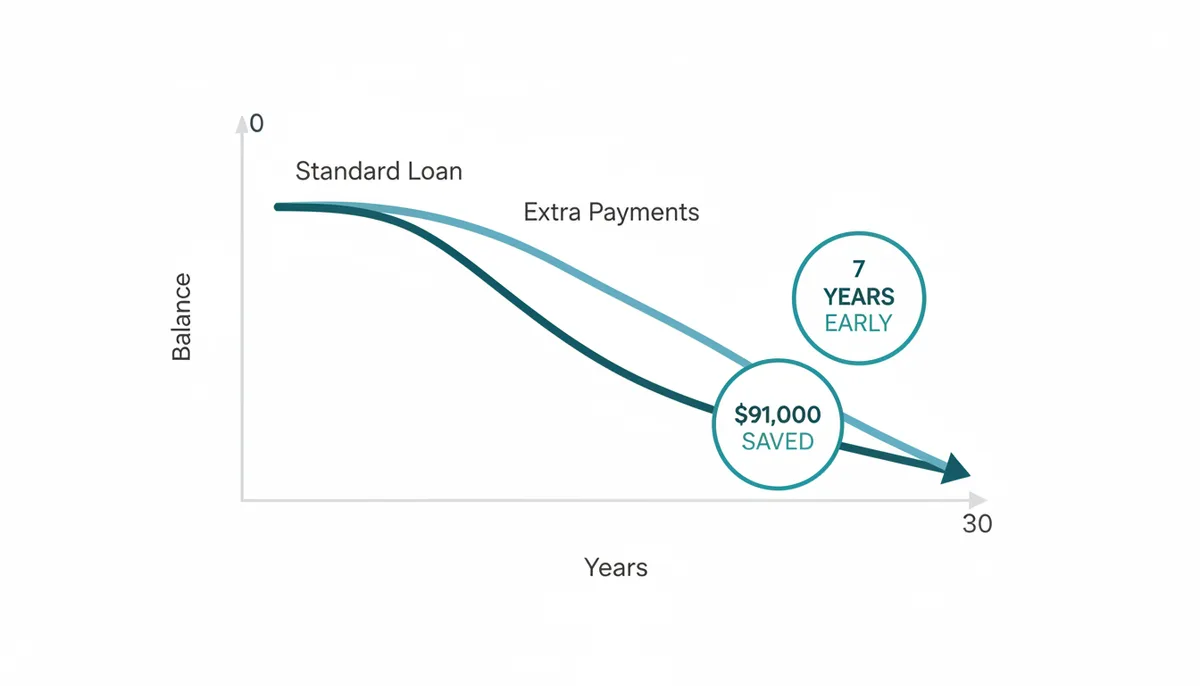
On the $300,000, 30-year loan at 6%, adding $200 a month to principal pays the loan off in about 23 years instead of 30 and saves roughly $91,000 in interest. Two hundred dollars a month, nearly seven years of payments erased. Even an extra $50 a month shortens the term by more than two years and saves close to $29,000.
Three ways to structure it
- Round up. Pay $1,900 or $2,000 instead of $1,799. It's painless to automate, and on this loan an extra $100–200 a month does the damage described above.
- One extra payment a year. Make a 13th payment whenever it suits you — bonus season, tax refund season. On a 30-year loan at 6%, this alone cuts the term to roughly 24 and a half years.
- Bi-weekly payments. Pay half your monthly amount every two weeks. Because there are 26 half-payments in a year, you quietly make 13 full payments instead of 12 — the extra-payment plan without ever feeling it. Confirm your servicer applies each half-payment on receipt rather than holding the first one until the second arrives.
Get the mechanics right
Extra money only saves interest if it actually reaches the principal, so designate it. Most servicer portals have an "apply to principal" option, and paper checks can carry the instruction in the memo line. Note also what extra payments don't do on a standard loan: they shorten the term rather than lowering future required payments. If you make a large lump-sum payment and want the monthly amount recalculated instead, ask about recasting — some lenders will re-amortize the remaining balance for a small fee.
Before you start, check your contract for prepayment penalties. Federal rules keep them off most home mortgages, but they still appear in some personal and auto loan agreements, where they exist specifically to protect the lender's interest income from the strategy in this section. And keep your priorities straight: extra principal earns your loan rate and nothing more, so build an emergency cushion, kill any credit-card balances (which charge three or four times your mortgage rate), and capture your full employer retirement match before you accelerate a 6% loan.
How Lenders Decide Which Loan Terms to Offer You
You don't choose a term from an infinite menu. The lender prices the risk of lending to you, and that pricing quietly shapes which terms you're offered and what each one costs. Three factors do most of the work.
Your credit score sets the rate — and the rate changes the term math. Better credit earns lower rates, full stop. But notice what the rate alone does to total interest on the same $300,000, 30-year loan: about $216,000 at 4%, roughly $492,000 at 8%. At high rates, long terms become brutally expensive, which makes improving your score before you borrow worth more than almost any term engineering you can do afterward.
Your debt-to-income ratio caps the payment — and the term becomes the adjustment valve. If the lender's DTI ceiling means your maximum housing payment is around $2,200, then a $300,000 loan at 6% simply cannot be a 15-year loan no matter how disciplined you are. Stretching the term is how lenders fit larger loans into fixed incomes — which is convenient, and also exactly how people end up with 84-month car loans.
The collateral sets the outer limit on time. Lenders match terms to the asset behind the loan. Houses tend to hold or grow value, so 30-year terms exist. Cars depreciate, so terms historically capped near 60 months — the creep to 72 and 84 says more about vehicle prices and sales tactics than about sound lending. Unsecured personal loans, backed by nothing, rarely stretch past five to seven years. A bigger down payment (lower loan-to-value) widens your options in every category, because it shrinks the lender's exposure from day one.
One disclosure cuts through all of it: the Truth in Lending Act requires lenders to show you the "Total of Payments" — the full amount you'll pay over the loan's life — before you sign. See your lender's disclosure for that number and use it in comparisons: it's the whole loan in a single box.
Frequently Asked Questions
Is it better to take a shorter loan term I can barely afford or a longer one that's comfortable?
Take the comfortable one. A payment you can barely afford has no room for a broken transmission, a medical bill, or a slow quarter at work — and falling behind costs far more than the interest you were trying to save. The smarter play is to take the longer term and voluntarily pay it like the shorter one whenever you can. You capture most of the interest savings, and when life happens you drop back to the required payment with no penalty and no damage to your credit. You're trading a small rate premium for flexibility, and for most households that's a good trade.
Can I change my loan term after I've already started paying?
Yes — that's refinancing. You take out a new loan, ideally at a better rate or with a different term, and use it to pay off the old one. Homeowners refinance from 30 years down to 15 when income grows; auto borrowers refinance when their credit improves. You'll have to re-qualify — credit, income, and DTI all get checked again — and you'll pay closing costs, so the new loan needs to beat the old one by enough to earn those costs back. If your only goal is a lower mortgage payment after a big lump-sum principal payment, ask about recasting instead; it re-amortizes the loan without a full refinance.
Does paying off a loan early hurt my credit score?
Sometimes, briefly, by a little. Closing an installment account can trim a few points because it changes your mix of open accounts and, eventually, the average age of your credit history. The dip is small and temporary, and a loan paid as agreed stays on your credit report for years. Weighed against being debt-free and keeping thousands of dollars of interest in your own pocket, it's a rounding error. Never keep a loan open just to protect your score.
What's the difference between interest rate and APR?
The interest rate is the price of borrowing the principal — the number that drives your monthly payment. The Annual Percentage Rate (APR) rolls the interest rate together with lender fees like origination charges, so it reflects the loan's fuller cost. Two loans can share a 6% rate while one carries a 6.3% APR and the other 6.6% — the second is the more expensive loan. Use the note rate for payment calculations and the APR when you're comparing offers across lenders.
If I make an extra payment, does the bank automatically apply it to the principal?
Not always — and the difference is worth real money. Unless you specify otherwise, some servicers treat extra money as an early payment: it sits in a holding account and covers next month's bill, interest included, which saves you almost nothing. You want the excess applied to principal only, so it immediately shrinks the balance that interest is charged on. Most online portals have a checkbox or a separate field for principal-only amounts; if you pay by check, write the instruction in the memo line. Then verify on your next statement that the balance dropped by the full extra amount.
Why would a bank offer a 7-year car loan if it's often a bad deal for the borrower?
Because it's a good deal for everyone except the person paying it. Long terms shrink the monthly payment, which lets dealers sell more expensive cars to more buyers — "can you get to $500 a month?" moves metal in a way the sticker price never could. The lender, meanwhile, collects interest for two extra years on a balance that declines slowly. The risks — years of negative equity, writing checks against a car worth a fraction of the loan — all sit with you. A lender offering you an 84-month term isn't doing you a favor; it's telling you the car costs more than you should spend.
Sources
- Consumer Financial Protection Bureau (CFPB) — Definitions of APR, principal, and interest, and consumer rights under the Truth in Lending Act (TILA). Backs claims about how P&I payments work and what lenders must disclose.
- Federal Student Aid (U.S. Dept. of Education) — Authoritative information on federal student loan terms, repayment plans (Standard, IDR), and how term length is determined. Supports the section on student loans.