What a Mortgage Calculator Leaves Out of Your Monthly Payment
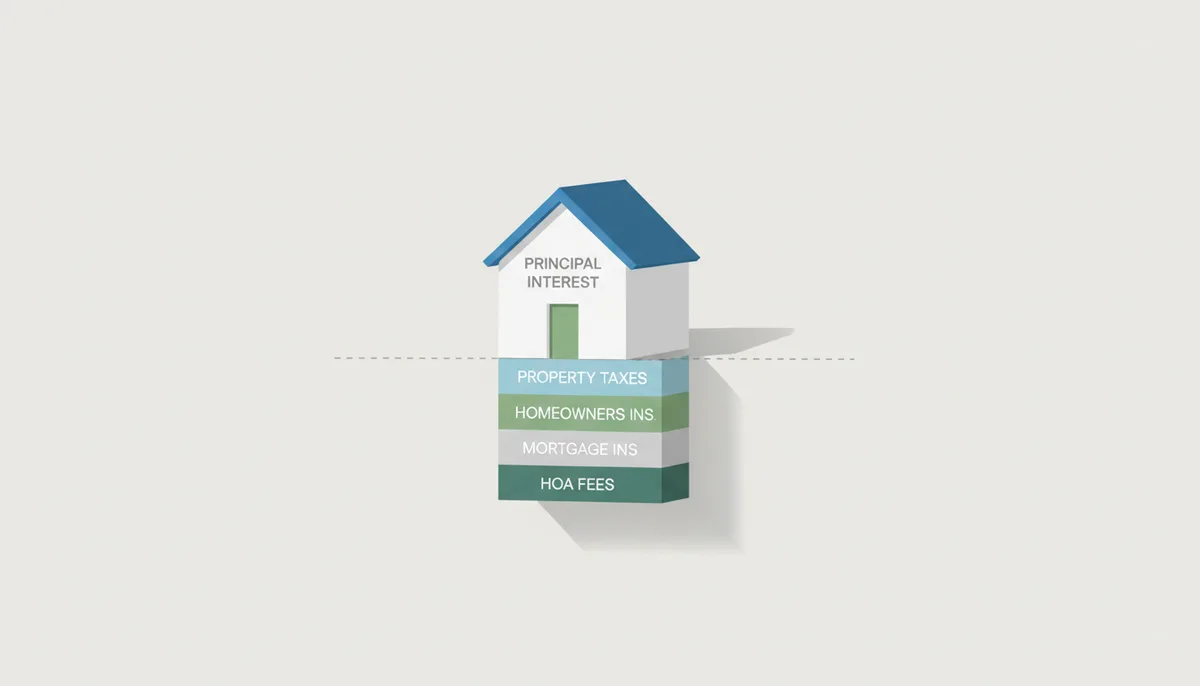
Put 10% down on a $320,000 house, borrow $288,000 at 6.5% for thirty years, and a basic mortgage calculator gives you a clean answer: $1,820 a month. That number comforts people. It fits the budget spreadsheet, it clears the gut check, and it quietly becomes what you believe the house costs.
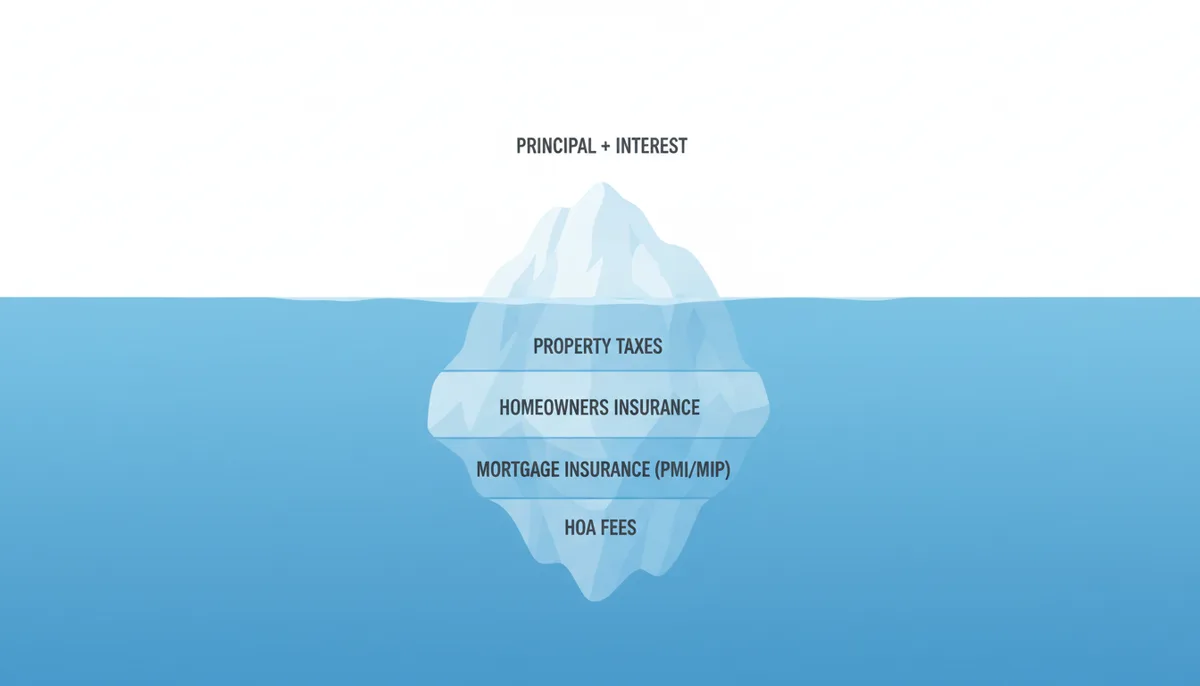
Then the first real statement arrives: $2,425. The extra $605 was always there — the calculator just never counted it. Add the HOA dues, the utilities, and the money you should be setting aside for the furnace, and the true monthly cost lands closer to $3,077. This guide walks through every piece of that gap and shows you how to estimate your real housing cost before you fall in love with a house you can't quite afford.
Why Your Calculator's Estimate Is Just the Beginning
A mortgage is the only loan most people repay for thirty years, yet the number everyone shops with covers only two of the four moving parts. The simple calculator gives you principal and interest. Principal is the borrowed money you're paying down; interest is the lender's charge for lending it. Your payment stays flat while the split shifts — early on, most of each payment is interest, and only a sliver reduces the balance. That shifting split is called amortization, and it's the only thing a bare-bones calculator models.
Lenders don't think in principal and interest. They think in PITI: Principal, Interest, Taxes, and Insurance. When a loan officer tells you the monthly payment, they mean the full PITI, and if your tax and insurance bills are escrowed — which they almost always are — that full number is what actually leaves your checking account each month.
The costs that hide behind the $1,820 in our example:
- Property taxes, collected monthly through escrow — $293 a month here.
- Homeowners insurance, also escrowed — $180 a month here.
- Mortgage insurance (PMI or, on FHA loans, MIP), which applies when you put down less than 20% — $132 a month here.
- HOA or condo fees, paid separately but counted by lenders — $85 a month here.
And beyond anything a lender tracks: maintenance and utilities. We'll get to every one of these.
How Property Taxes Get Into Your Mortgage Payment
Someone in our example city collects $3,520 a year in property tax from a $320,000 house, and that money funds schools, road repaving, the fire department, and the county budget. Property tax is levied by overlapping local governments — county, city, school district, sometimes special districts for water or libraries — and each one tacks its rate onto your bill.
The mechanics matter, because a wrong assumption here wrecks a budget. Your tax is the assessed value multiplied by the local tax rate. Note the phrasing: assessed value, not market value. Many jurisdictions assess homes at a fraction of what they'd sell for, then apply a bigger-looking rate. Others assess at full market value. Before you compare rates across states, find out which system the local assessor uses.
Some places express the rate in mills — one mill is $1 of tax per $1,000 of assessed value. An 11-mill levy on a $320,000 assessed value works out to $3,520 a year (320 × $11), or $293 a month. High-tax areas can run three times that, which would push the same house past $800 a month in taxes alone. The range across the country runs from well under half a percent of value per year to well over two percent.
Here's how that reaches your payment. The lender takes the expected annual tax bill and divides it by twelve. That slice rides along with your principal and interest each month, accumulating in an escrow account until the county bills come due — usually once or twice a year.
What trips people up is that the tax slice isn't fixed. Assessments get revisited, voters approve school levies, and reassessment cycles roll through counties on their own schedule. Two traps deserve special mention:
- Reassessment on sale. In states that cap annual increases for existing owners, the assessment often resets to the purchase price when the home changes hands. The seller's $2,600 tax bill can become your $3,500 bill in the first full year you own the place.
- New construction. Buy a newly built home and the first tax bill may be based on vacant land. Once the assessor catches up and values the land plus the house, the bill jumps — sometimes sharply.
Every increase flows straight into your escrowed monthly payment at the next analysis. We'll cover that adjustment process in the escrow section below.
The Insurance Your Lender Actually Requires
Homeowners insurance protects the structure and your belongings against fire, wind, theft, and a long list of other events, and it throws in liability coverage if someone gets hurt on your property. Lenders call the part they care about hazard insurance, and they require it for a blunt reason: the house is their collateral. If it burns down uninsured, their loan is suddenly backed by a vacant lot. Your policy will list the lender as the loss payee, meaning big claim checks go through them.
One thing buyers routinely get wrong: you insure the home for its rebuild cost, not your purchase price. A $320,000 purchase price includes the land, and land doesn't burn. The coverage target is what it would cost to reconstruct the dwelling — sometimes more than you paid, sometimes less.
Premiums get priced off a bundle of factors: the replacement-cost estimate, the age and material of the roof, the construction type, how far you are from a fire station, local claim history, your own claim history, the deductible you pick, and — in most states — a credit-based insurance score. In our example, a $2,160 annual premium becomes $180 a month inside the mortgage payment, collected into escrow the same way taxes are.
Standard homeowners policies carry a quiet exclusion list. Two exclusions have real consequences for your budget:
- Flood. Flood damage requires a separate policy, and if the home sits in a federally designated high-risk flood zone, a regulated lender will require you to carry it. Often it's escrowed right alongside the main policy.
- Earthquake. Same story — separate policy, priced on top of the base premium.
In some coastal areas, even wind coverage gets split into a separate policy with its own percentage-based deductible. Get quotes on the specific address before you finalize a budget, because the same house in two different zip codes can carry wildly different premiums.
Mortgage Insurance: PMI and MIP
Mortgage insurance has the most misleading name in the whole transaction, so be clear on this: it protects the lender, not you. If you default and the foreclosure sale doesn't cover the balance, the insurer pays the lender's loss. You write the check; they take the protection. It exists because loans above 80% loan-to-value — LTV, meaning the loan balance divided by the home's value — historically default more often and recover less.
On conventional loans, it's called Private Mortgage Insurance (PMI), and it typically kicks in whenever you put down less than 20%. Annual cost commonly runs from about half a percent to one and a half percent of the loan balance, priced off your credit score and LTV — cleaner credit and bigger down payments land at the cheap end. In our example: 0.55% of $288,000 is $1,584 a year, or $132 a month.
FHA loans use a different structure called the Mortgage Insurance Premium (MIP). There's an upfront premium — usually 1.75% of the loan amount, typically rolled into the balance — plus an annual premium split into monthly installments. FHA applies MIP to nearly every borrower regardless of down payment size. (VA loans go a different route entirely: no monthly mortgage insurance, but a funding fee at closing.)
The difference that matters most over time is how each one ends. For conventional PMI, federal law sets two exit doors: you can request cancellation once your LTV reaches 80% (based on the original or, with some servicers, current appraised value), and the servicer must automatically terminate it at 78% — that's 22% equity — as long as your payments are current. FHA MIP is harsher: put down less than 10% and the monthly premium runs for the life of the loan; put down 10% or more and it drops off after eleven years.
| Attribute | Conventional Loan (PMI) | FHA Loan (MIP) |
|---|---|---|
| Purpose | Covers the lender's losses if you default | Same — covers the lender, not you |
| Who it protects | The lender | The lender |
| Typical trigger | Down payment under 20% (LTV above 80%) | Nearly all FHA loans, regardless of down payment |
| Upfront cost? | Usually none for monthly-premium plans | Yes — typically 1.75% of the loan amount, usually financed |
| Monthly cost? | Yes, roughly 0.5%–1.5% of the loan balance per year, split into monthly installments | Yes — an annual premium set by HUD, split into monthly installments |
| How to cancel | Request removal at 80% LTV; automatic termination at 78% LTV with a clean payment record | Under 10% down: lasts the life of the loan. 10% or more down: ends after 11 years |
One decision rule worth internalizing: PMI is temporary if you let it be. Every extra dollar of principal moves the LTV down, and once you cross 80%, you're paying for nothing. Conversely, if an FHA loan is your only path in, know that many borrowers eventually refinance into a conventional loan specifically to escape lifetime MIP.
How Escrow Bundles All of It Into One Bill
The reason all these costs hide inside "the mortgage payment" comes down to one mechanism: the escrow account, also called an impound account. It's a holding account run by your mortgage servicer — the company that collects your payment, which may or may not be the company that lent you the money.
The mechanics are simple. Each month, your payment splits. Principal and interest flow to the lender and pay down the loan per the amortization schedule. The tax and insurance slices flow into escrow and sit there. Then, when the county tax bill or the annual insurance premium comes due, the servicer pays it from the escrow balance. You never see the lump sum unless something goes wrong.
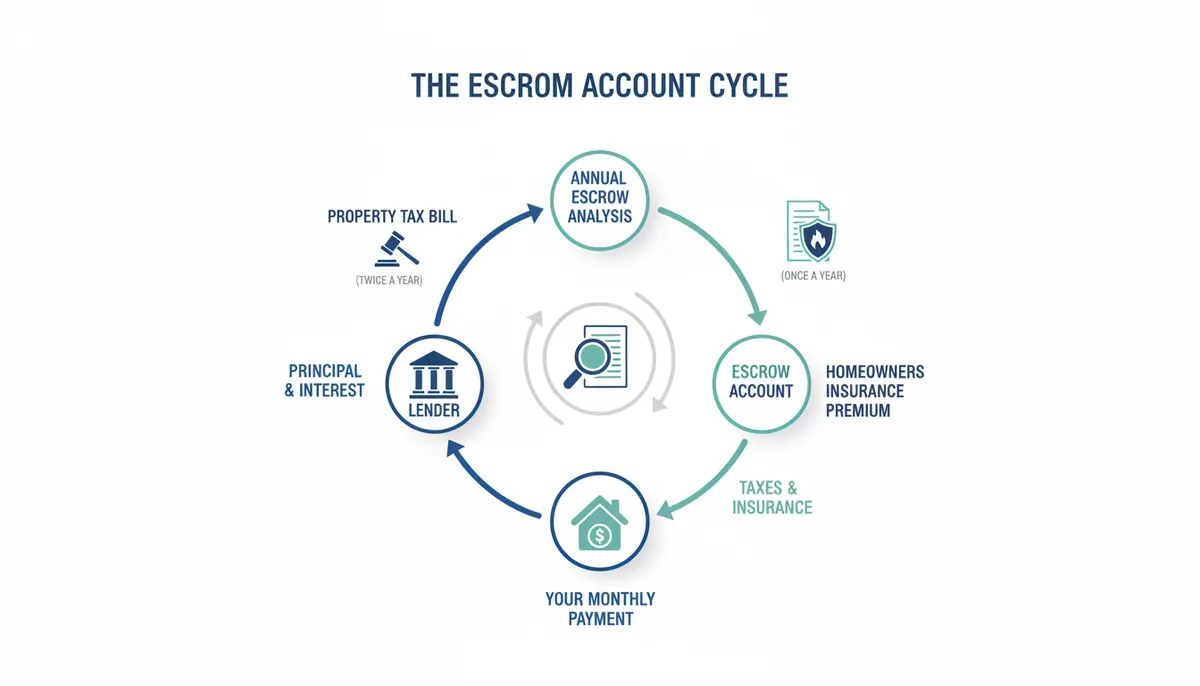
Once a year, the servicer runs an escrow analysis. They project the coming year's tax and insurance bills, check the account balance, and recalculate your monthly escrow slice. Federal rules let them hold a cushion of up to two months' worth of escrow payments as a buffer. If the balance is too low — because taxes jumped or your insurer raised rates — the payment rises to cover the higher bills plus rebuild the cushion. Shortfalls are usually spread across the next twelve months, though you can typically pay a lump sum instead. If there's a surplus above $50, the servicer has to refund it.
This is why a "fixed-rate mortgage" doesn't mean a fixed payment. The principal-and-interest part is fixed. The escrow part floats with your county's tax appetite and your insurer's pricing. Buyers who stretch to the edge of affordability on a $2,425 statement have been known to get a $2,580 statement eighteen months later.
Can you skip escrow? Sometimes, if you have at least 20% equity and a willing lender — some charge a small fee or rate bump for the waiver. Think hard before taking it. Opting out means writing a $3,500-plus check to the county and a $2,000-plus check to your insurer on your own discipline. Miss the tax deadline and you'll rack up penalties; let the insurance lapse and the lender will buy force-placed insurance on your behalf — coverage that costs far more than a normal policy, protects only the lender, and gets billed to you anyway. For most people, escrow is cheap automation of bills you'd otherwise botch.
HOA and Condo Fees: The Bill Your Servicer Doesn't Touch
If the home sits in a homeowners association or condominium building, a slice of your budget goes to dues that cover exterior maintenance, landscaping, pools, elevators, insurance on common areas, reserve funds for future repairs, and sometimes utilities like water, sewer, and trash. Dues are mandatory — they're attached to the property, not optional — and they range from under $100 a month in modest suburban HOAs to well over $1,000 in full-service condo buildings.
Here's the operational detail buyers miss: HOA dues are almost never escrowed. You pay them directly to the association, usually on a different due date, through a different portal, to a different entity than your mortgage servicer. Your $2,425 statement in our example doesn't include the $85 — that bill arrives separately, and forgetting it is an easy way to earn late fees in your first month of homeownership.
Don't let the separate billing fool you into thinking lenders ignore it. When they qualify you, the HOA fee goes straight into your debt-to-income ratio alongside the full PITI. A $400 condo fee can erase tens of thousands of dollars of borrowing power. Lenders treat it as housing cost because it behaves like one: it's mandatory, it's monthly, and falling behind can theoretically cost you the home through an association lien.
One more HOA artifact deserves a permanent place in your risk assessment: the special assessment. When the reserve fund can't cover a big capital project — a roof replacement across every building, new elevators, storm damage — the association levies a one-time charge on every owner, sometimes thousands of dollars, on top of regular dues. Before you buy into an association, read the budget, the reserve study, and the meeting minutes. Healthy reserves and boring minutes are what you want to see.
Maintenance and Utilities: The Costs No Lender Will Track for You
Everything so far at least shows up in a lender's math. Maintenance doesn't, and it's the line item that separates homeowners who stay afloat from homeowners who put a water heater on a credit card.
Two rules of thumb circulate for a reason. The 1% rule says budget 1% of the home's value per year: on a $320,000 house, that's $3,200 a year, or about $267 a month. The square-footage rule says budget $1 per square foot per year: on a 2,000-square-foot home, about $167 a month. Use whichever is higher if the home is older, whichever is lower if it's new — but use one of them. These aren't predictions; they're sinking funds that absorb the years when the roof, the HVAC, and the water heater all seem to coordinate their failures. For context on what you're funding: asphalt shingle roofs often last 20 to 30 years, HVAC systems roughly 15, water heaters around 10. A home built in 2009 is a maintenance schedule wearing a charming exterior.
Utilities belong in this budget too, because renters routinely underestimate them. No landlord subsidizes your water, sewer, trash, gas, or electric anymore, and nobody rolls internet into the rent. Apartment dwellers moving to a house often see their combined utility spend double, simply because there are more rooms to heat, more fixtures drawing water, and a lawn that drinks all summer. Before you commit to a specific house, ask the seller or the agent for twelve months of actual utility bills. Real numbers beat any estimate, and most sellers will hand them over.
How to Estimate Your Real Monthly Housing Cost
You now know every component. Here's the process for assembling them on a specific property, before you make an offer:
- Get principal and interest from a full-featured calculator. The mortgage calculator on CalculatorLine has fields for property taxes, homeowners insurance, and PMI alongside loan amount, rate, and term, so you can model the whole PITI instead of just the first two letters. A lender quote does the same job with live numbers.
- Pull the property tax history. Real estate listings usually show it; the county assessor's website always does. Note both the annual bill and the assessed value, and ask whether a sale triggers reassessment in that jurisdiction. Divide the realistic annual figure by twelve.
- Get actual insurance quotes. Two or three insurers, on the exact address, with the deductible you'd really choose. This takes twenty minutes and is the only reliable number — online averages are useless at the property level. Ask about flood and earthquake exposure while you're at it.
- Get a mortgage insurance estimate from your lender. It depends on your LTV, credit score, and loan type, so a lender can price it specifically rather than you guessing from a range.
- Confirm HOA dues from the listing or association documents, and add them to your monthly figure even though you'll pay them separately.
- Budget maintenance with the 1% rule — 1% of the purchase price per year, divided by twelve.
- Fill in utilities from the seller's actual bills where possible.
Here's the framework with our running example filled in. The subtotal line is what a lender counts when qualifying you; the grand total is what your household actually spends.
| Item | How to find or estimate it | Worked example ($320k home, 10% down) |
|---|---|---|
| Principal & Interest | Loan amount, rate, and term from a full-featured calculator or lender quote | $1,820 |
| Property Tax | County assessor site or listing history, divided by 12 | $293 |
| Homeowners Insurance | Real quotes on the address, annual premium ÷ 12 | $180 |
| Mortgage Insurance (PMI/MIP) | Lender estimate based on your LTV, credit, and loan type | $132 |
| HOA / Condo Fee | Listing or association documents (paid separately) | $85 |
| Subtotal: lender-counted payment | Sum of the above | $2,510 |
| Maintenance (1% rule) | 1% of purchase price per year ÷ 12 | $267 |
| Utilities | Seller's past 12 months of bills, averaged | $300 |
| Grand total: true monthly cost | Subtotal + maintenance + utilities | $3,077 |
Decide against the grand total, not the subtotal. A $2,510 lender number that already makes you nervous will become $2,650 after the first reassessment and a rate hike from your insurer. Buy the house whose grand total leaves room for the sinking fund — because the furnace doesn't care what the calculator told you.
Why Your Second-Year Payment Won't Match Your First
The biggest payment shock doesn't come from a cost nobody told you about. It comes from a cost you knew about that was priced with stale numbers. Escrow at closing is built on estimates, and two of those estimates — the tax bill and the insurance premium — have a habit of being wrong in your favor in year one, then correcting all at once in year two.
Here's how it plays out on the $320,000 house from earlier. Say the closing agent built your escrow using the seller's old tax bill of $2,640 a year ($220 a month), not the $3,520 the county will assess once the sale resets the value. Your first-year payment is $2,352 — principal and interest of $1,820, tax escrow of $220, insurance of $180, PMI of $132. Comfortable. You budget around it.
Then the county reassesses. The first tax bill issued under your name is $3,520, and the servicer pays the actual amount from escrow — $880 more than the account collected. At the same first renewal, your insurer raises the premium from $2,160 to $2,430, adding a $270 shortage of its own. The annual escrow analysis now does two things at once, and this is the mechanism people misunderstand:
- It resets the run rate. The tax slice rises from $220 to $293 a month; the insurance slice from $180 to $203. That increase is permanent.
- It recovers the shortage. The combined $1,150 shortfall gets spread over the next twelve months — about $96 a month — on top of the new run rate. That part is temporary.
The result, year by year:
| Component | Year 1 (stale estimates) | Year 2 (correction + shortage) | Year 3 (settled) |
|---|---|---|---|
| Principal & Interest | $1,820 | $1,820 | $1,820 |
| Property tax escrow | $220 | $366 | $293 |
| Insurance escrow | $180 | $226 | $203 |
| PMI | $132 | $132 | $132 |
| Total payment | $2,352 | $2,544 | $2,448 |
Two things to notice. The principal-and-interest line never moves — that's what "fixed rate" actually fixes. And the payment settles at $2,448, not the $2,352 you planned around. The year-two spike to $2,544 is the shortage recovery stacked on the correction; it fades, but the correction doesn't.
You have two defenses, and I'd use both. First, before closing, ask which tax figure the escrow estimate uses. If it's the seller's bill in a state that reassesses on sale, push for the estimate based on your purchase price — some lenders will do this if you ask, some won't. Second, if they won't, budget at the higher number anyway and bank the difference in a savings account. When the $1,150 shortage arrives, you pay it as a lump sum, skip the $96-a-month recovery surcharge entirely, and your payment moves straight to the settled $2,448. The trade-off is real — that's $1,150 you could have held — but the alternative is discovering in month fourteen that your "affordable" house costs $192 more per month than the number you bought it on.
Frequently Asked Questions
Can I choose not to have an escrow account?
Sometimes, but it's uncommon. Most lenders require escrow whenever your equity is under 20%, and many state laws make escrow mandatory regardless. If you do qualify to opt out, the responsibility shifts entirely to you: property tax bills and insurance premiums arrive as large lump sums, and missing them has real consequences — tax penalties, force-placed insurance, coverage gaps. For most households, escrow is a useful forced-savings mechanism rather than a burden.
What happens if my property taxes or insurance costs go up?
Your servicer catches it at the annual escrow analysis. They project the new bills, compare against the account balance, and adjust your monthly payment upward to cover the increase and rebuild the cushion they're allowed to hold — up to two months of escrow payments. The shortage gets spread across the next twelve months unless you choose to pay it as a lump sum. This is why fixed-rate borrowers still see payment changes.
How can I get rid of PMI on my conventional loan?
Two doors, both defined by federal law for borrower-paid PMI. You can request cancellation once your loan-to-value ratio reaches 80% — either through paying down the balance or, depending on servicer rules, through appreciation proven by a new appraisal. And the servicer must automatically terminate PMI when your LTV hits 78% on the original amortization schedule, provided your payments are current. Keep your payment history clean, because that request at 80% requires a good record.
Do all mortgage calculators ignore these extra costs?
No. Basic ones show only principal and interest, which is where most of the confusion starts. More complete mortgage calculators — including the one on CalculatorLine — include fields for property taxes, homeowners insurance, and PMI, so you can model a realistic PITI instead of a fragment of it. Use the full-featured version before you draw any budget conclusions.
What is a special assessment from an HOA?
A one-time fee the association levies on top of your regular dues when the reserve fund can't cover a major capital expense — a new roof for the clubhouse, elevator replacement, road repairs inside the community, storm damage. Assessments can run from hundreds to tens of thousands of dollars per household. Before buying into an association, review the reserve study and recent meeting minutes; an underfunded reserve is a special assessment with a question mark on the timing.
Is a home warranty the same as homeowners insurance?
No, and the difference matters. Homeowners insurance covers damage from specific events — fire, wind, theft, liability claims. A home warranty is a service contract that pays to repair or replace systems and appliances — HVAC, water heater, refrigerator — when they fail from normal wear and tear. Insurance is mandatory with a mortgage; a warranty is an optional add-on that some buyers find useful in the first years of owning an older home. One doesn't substitute for the other.
Sources
- Consumer Financial Protection Bureau (CFPB) — Definitions and federal regulations concerning escrow accounts, PITI, mortgage servicing, and consumer rights.
- U.S. Department of Housing and Urban Development (HUD) — Authoritative information on FHA loans, including the specifics of Mortgage Insurance Premiums (MIP).
- Fannie Mae — Guidelines for conventional loans, including requirements for Private Mortgage Insurance (PMI) and loan-to-value (LTV) calculations.
- Insurance Information Institute — General explanations of what homeowners insurance covers, how premiums are calculated, and the difference between it and other products like flood insurance.
- National Association of REALTORS® — General statistics and process information about home buying, including the role of property taxes and HOA fees in a transaction.