How to Convert Currency Without Mixing Up Base and Quote Currencies
You're browsing a flight booking site for a trip to Tokyo, or perhaps comparing insurance quotes from a UK provider. The price shows up in a currency you don't hold. You grab your calculator, type in the amount, multiply by the exchange rate you saw in the news, and arrive at a number. You click "Pay." Days later, your bank statement reveals the transaction was charged a significantly different amount, or worse, the merchant cancels the order because the payment didn't cover the invoice.
The frustration isn't just the lost time or the extra fee. It's the inability to spot the error immediately. A miscalculation in currency conversion often produces a result that looks perfectly reasonable. You converted Euros to Dollars? The number is smaller, so it must be Euros to Dollars. That intuition is exactly what catches people out.
Every error in currency conversion traces back to a single point of failure: reversing the relationship between the base and quote currencies. The entire global foreign exchange system is built on a rigid convention where one currency is the commodity being priced, and the other is the money used to pay for it. Break that rule, and your math becomes fiction even if the arithmetic is correct.
This guide eliminates the guesswork. You will learn a mental model that makes the correct operation obvious every time, a step-by-step method for manual calculations, and a checklist for using online tools without falling into traps that cause budget shortfalls.
Why Do So Many Currency Conversions Go Wrong?
The primary reason conversions fail is that exchange rates are directional, but human language often treats them as symmetrical. When you hear "The euro-dollar rate is 1.08," you might assume this number works both ways. It doesn't.
Consider a scenario involving GBP/USD. Let's say the rate is 1.25. If you are a British tourist in New York holding pounds, you want to know how many dollars your £500 will buy. If you blindly multiply, you get $625. If you divide, you get £400. Both answers are mathematically possible. Only one describes reality. The difference stems from whether you treat the pound as the item being priced (the base) or the pricing money (the quote).
Mistakes compound when people confuse the order of the pair with the action they need to take. You see EUR/USD on your phone and start plugging numbers into a converter. If the converter asks for "Amount" and "Currency," and you fill those in without thinking about which side you are on, you might select the wrong input field or apply the operation backwards. The calculator line tools handle the heavy lifting, but relying on them requires you to provide the correct context. If you feed the tool a rate in the wrong orientation, or if you are doing manual estimates to sanity-check the tool, you end up with a wrong number that passed the initial test because it felt right.
The confusion also thrives in cross-rates. When trading AUD/CAD, neither currency is the US dollar. Traders unfamiliar with the notation sometimes default to USD-centric logic, leading to inverted expectations. The base/quote framework solves this by applying the same logic regardless of which two currencies are involved.
Once you internalize that a currency pair always represents a trade-off—one unit of the first currency for some amount of the second—you remove the ambiguity. The rest is just execution.
The '1 of THIS equals X of THAT' Rule: Mastering Base vs. Quote
Forget complex finance jargon for a moment. Every exchange rate answers a single question: "How much of Currency B do I get for one unit of Currency A?"
Currency A is the Base currency. Currency B is the Quote currency. The rate is the price of that one unit of Base in terms of Quote.
This is the anchor. No matter what tools you use, this rule holds. The base currency is never fractional in the quote. It is always one whole unit. The quote currency carries the decimal value. This structure forces clarity because it defines the reference point. You are always valuing exactly one unit of the first currency.
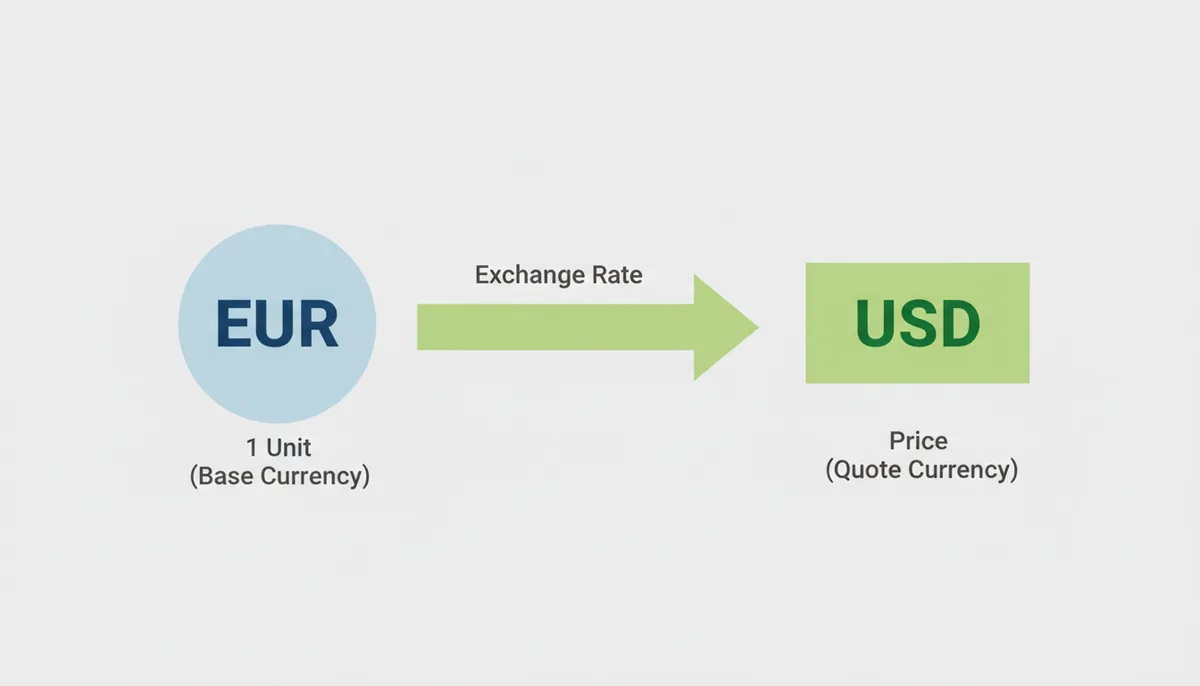
Look at EUR/USD = 1.08.
Read it aloud: "One Euro equals 1.08 US Dollars."
The Euro is the base. It is the asset. You are determining its worth in dollars. The US dollar is the quote. It is the measure. The number 1.08 is the exchange rate. It tells you that the Euro is currently valued slightly higher than the dollar.
If the pair were USD/EUR instead, the meaning flips completely. USD/EUR = 0.92 would mean one US Dollar equals 0.92 Euros. The base switched. Now you are pricing the dollar in euros. The decimal moved left. The logic remains identical, but the perspective changed.
In professional contexts, the base currency is sometimes called the commodity currency, and the quote currency the counter currency. These terms appear in broker statements and financial reports. Recognizing them helps when reading deeper analysis, but the base/quote terminology is sufficient for daily conversion.
Understanding this distinction prevents the most common mental slip: assuming the rate acts as a simple multiplier in all directions. It does not. The rate is a ratio relative to one unit of base. If you hold units of quote and want base, you cannot multiply. Multiplying by 1.08 when you hold dollars and want euros would give you a larger number of euros, implying the euro is worth less than a dollar, which contradicts the rate. You have to divide to compress the dollar amount into euro equivalents.
When you commit the '1 of THIS' rule to memory, you stop calculating from scratch. You identify the pair, locate the base, and immediately know the starting point. One base unit costs Rate quote units. Everything else derives from that statement.
How to Read Any Currency Pair: Direct, Indirect, and Cross Rates
Currency markets operate globally, so a universal notation is essential. This is why the ISO 4217 standard exists. Every currency has a three-letter code derived from the country or region. USD for United States Dollar. EUR for Euro. JPY for Japanese Yen. GBP for British Pound Sterling.
A pair combines two of these codes with a forward slash, like GBP/JPY. The slash separates base from quote. The space before and after the slash is optional but improves readability in documents. In digital interfaces, spaces may be stripped, but the order remains fixed.
Notation varies by region due to quotation conventions. Financial centers prefer either direct or indirect quotes depending on what is convenient for their residents.
A direct quotation expresses the price of one unit of foreign currency in terms of domestic currency. For a trader in the United States viewing GBP/USD, this is a direct quote. The pair lists the British pound as the base (foreign) and the US dollar as the quote (domestic). The American resident sees exactly how many dollars it takes to buy one pound. An indirect quotation expresses the price of one unit of domestic currency in terms of foreign currency. For a trader in Germany, EUR/USD serves as an indirect quote. The euro acts as the domestic base, and the rate shows how many foreign dollars you receive for one euro.
This distinction matters because it dictates how quickly you grasp the magnitude of movement. If you live in Switzerland and watch USD/CHF = 0.88, a rise to 0.90 means the franc weakened. You now need more francs to buy one dollar. If you mistakenly assume a direct quote framework when your domestic currency sits in the quote position, you will misread whether your local money is strengthening or weakening. Knowing whether the domestic currency appears in the base or quote column prevents this confusion. You simply check the pair orientation, determine the directional impact of a rising number, and adjust your expectations accordingly.
Cross rates complicate the picture further. A cross rate involves two non-dollar currencies, such as AUD/CAD or EUR/GBP. Historically, banks calculated these indirectly using the dollar as a bridge. Today, interbank markets price crosses directly due to high liquidity, but the base/quote logic remains unchanged.
Treat AUD/CAD exactly like any other pair. AUD is base. CAD is quote. One Australian dollar costs a certain number of Canadian dollars. If the rate is 0.91, the Australian dollar is currently trading at a discount to the Canadian dollar. You apply the same '1 of THIS' rule. One AUD costs 0.91 CAD. Directional calculation follows the same multiplication or division logic based on which currency you hold.
Cross rates appear frequently in emerging market contexts or when corporations manage hedging across regional subsidiaries. Mastering the base/quote reading style allows you to parse these pairs instantly without needing to reference a dollar benchmark.
The Foolproof Formula for Manual Conversions
Online converters save time, but they mask the underlying mechanics. When a rate shifts suddenly, or you need a quick estimate to decide whether a transaction is viable, you need a reliable manual method. The two-rule system below handles every scenario.
Before applying the rules, confirm two facts:
- The current exchange rate for the pair in question.
- Which currency you currently hold (your starting amount).
Then follow the flow:
- Rule 1: If you HAVE the Base currency, MULTIPLY by the rate.
You are converting from base to quote. Since one base unit equals Rate quote units, your total base units simply scale up (or down) by that multiplier. Total Quote = Amount Base × Rate. - Rule 2: If you HAVE the Quote currency, DIVIDE by the rate.
You are converting from quote to base. You possess the pricing money and need the commodity units. Division determines how many base units fit into your quote amount. Total Base = Amount Quote ÷ Rate.
Let's work through a concrete example. Assume the pair is GBP/USD at 1.25. The British pound is the base. The US dollar is the quote.
Scenario A: You hold £500 and want to know the value in USD.
You have the base (£). Rule 1 applies. Multiply.
Calculation: £500 × 1.25 = $625.
Result: £500 converts to $625.
Scenario B: You hold $500 and want to know the value in GBP.
You have the quote ($). Rule 2 applies. Divide.
Calculation: $500 ÷ 1.25 = £400.
Result: $500 converts to £400.
Notice how the operations differ despite using the exact same rate and a similar amount. Multiplying increased the number; dividing decreased it. Both outcomes are valid within their contexts, but swapping the operation yields nonsense. If you tried Scenario B by multiplying, you'd get $625 worth of pounds, which violates the rate structure.
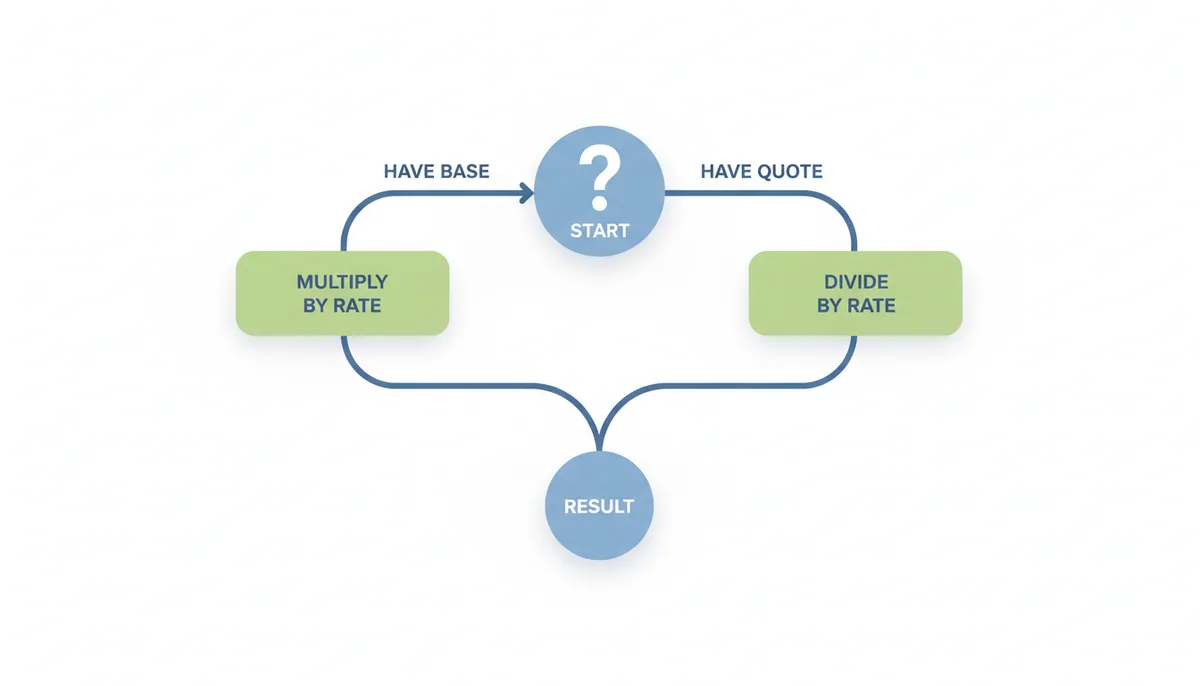
This formula works for any pair. Whether dealing with G10 majors or exotic crosses, the relationship holds. Identify base, identify holder, select operator. Simple.
Edge case: Zero and small decimals. Some pairs feature low-valued quote currencies, like VND or KPW. The rate number will be large, e.g., USD/VND = 24,500. The logic stays the same. Have USD? Multiply. 1 USD × 24,500 = 24,500 VND. Have VND? Divide. 24,500 VND ÷ 24,500 = 1 USD. The large multiplier reflects the purchasing power difference. The mechanism does not break.
Rounding introduces small errors in manual work, especially with high-precision rates. Bank transfers use many decimal places. Estimates rounded to two decimals are fine for planning but insufficient for execution. Carry extra digits during calculation, round only at the final step to the appropriate precision for the currency.
Going Pro: Why You Never Get the Rate You See on Google
Search engines display exchange rates under "Mid-Market Rate." News sites print mid-rates. Your economic dashboard shows mid-rates. These numbers represent the midpoint between what buyers are willing to pay and what sellers are asking. They are theoretical benchmarks, not executable prices.
In the real market, dealers price risk. The bid price is the rate at which a dealer buys the base currency from you. The ask price is the rate at which the dealer sells the base currency to you. Dealers buy low and sell high. The ask always exceeds the bid.
The gap between bid and ask is the spread. It compensates the dealer for liquidity provision and volatility exposure. You effectively pay the spread on every conversion. When you exchange money, you sell your source currency and buy the destination currency. This involves two legs, each carrying a spread cost, or a wider spread on a single leg if using a specialized converter.
Understanding bid/ask is critical for accurate planning. If you budget a trip assuming you can transact at the mid-rate, you will consistently underspend. The actual cost includes the spread overhead.
| Currency Pair | Mid-Market Rate | Bid Price (Sell) | Ask Price (Buy) | Spread (Pips) |
|---|---|---|---|---|
| EUR/USD | 1.0850 | 1.0848 | 1.0852 | 4 |
| GBP/USD | 1.2620 | 1.2616 | 1.2624 | 8 |
| USD/JPY | 149.50 | 149.46 | 149.54 | 8 |
| AUD/CAD | 0.9120 | 0.9115 | 0.9125 | 10 |
Review the table above. For EUR/USD, the mid is 1.0850. If you hold euros and sell them for dollars, you receive the bid of 1.0848. You lose 2 pips compared to the mid. If you need dollars and must buy euros first, you face the ask of 1.0852. You pay 2 pips extra. The total friction is 4 pips.
Spreads vary by liquidity. Major pairs like EUR/USD and USD/JPY enjoy tight spreads because volume is enormous. Exotic pairs, like USD/TRY or EUR/HUF, carry wide spreads. Liquidity dries up, risk rises, and dealers widen the gap to protect themselves. If you regularly move money into emerging market currencies, the spread alone can consume a percentage point or more of value. Factor this into cost analysis before committing capital.
Pip stands for "Percentage in Point," the smallest quoted increment. For most pairs, a pip is 0.0001. For yen pairs, a pip is 0.01. The spread is measured in pips. Traders calculate pip value to assess position sizing. Retail converters often show rates rounded, obscuring the pip-level detail, but the principle remains: better liquidity means tighter spread, which means lower transaction cost.
Always distinguish mid-market rates from actionable rates. Use mid-rates for relative comparisons and historical trends. Use bid/ask ranges for actual conversion projections. If a service promises mid-market rates with zero markup, verify the business model. Spreads exist for a reason. Low-cost providers usually bundle fees elsewhere or rely on volume arbitrage.
A Practical Checklist for Using Any Online Currency Converter
Digital tools streamline conversion by handling base/quote logic automatically. CalculatorLine's currency converter, for instance, presents fields labeled "From" and "To." You enter your amount, select the pair, and the engine computes the result. The tool identifies which input matches the base or quote and applies the correct formula. You avoid manual inversion errors entirely.
However, automated tools introduce new risks if used carelessly. A wrong selection overrides the benefit. Before hitting convert, run this checklist.
1. Verify the pair orientation.
Some converters auto-suggest pairs based on popular searches. Ensure the displayed pair matches the transaction. If the merchant invoices in GBP, check that your converter targets pounds. Entering amounts into a tool configured for the reverse pair leads to silent failures. Confirm the base and quote align with your intent.
2. Perform a sanity check.
Estimate mentally before trusting the screen. If converting from a stronger currency to a weaker one, expect the number to increase. If converting USD to JPY at 149, $100 should become roughly 14,900 yen. The number grows significantly. If the tool outputs 149 yen, you inverted the input. Catch the flag early. Reverse the logic: Did you multiply when you should have divided? Did you swap base and quote?
3. Check the rate timestamp.
Forex markets move continuously. Rates shift every second during trading hours. A cached rate from yesterday might deviate by 0.5% or more, particularly during geopolitical events or central bank announcements. Most reputable tools update live, but some aggregate feeds lag. If making a decision sensitive to rate variance, confirm freshness. For budget planning, use recent averages. For execution, use live quotes.
4. Watch hidden fees.
A competitive rate does not guarantee a good deal. Some platforms offer mid-market-looking rates but add processing fees, withdrawal charges, or poor settlement terms. Always review the total received amount. The conversion formula yields the gross equivalent; deduct costs to find net value. CalculatorLine focuses on pure mathematical calculation, presenting the rate-based result transparently. Commercial services layer commercial costs on top. Keep the distinction clear.
5. Validate decimal precision.
Ensure the tool displays enough decimal places for your needs. Large transactions require high precision. Rounding errors accumulate. If converting millions, a 2-decimal rounding can equate to substantial value loss. Adjust settings if available. Otherwise, carry digits in downstream calculations.
Using this checklist turns reliance on technology into informed supervision. You keep control of assumptions and catch discrepancies before they propagate.
The 3 Most Common Conversion Pitfalls (and How to Avoid Them)
Even experienced planners stumble over familiar traps. These pitfalls recur because they exploit cognitive shortcuts. Awareness stops repetition.
| The Mistake | A Concrete Example | The Fix |
|---|---|---|
| Inverting the calculation direction | Hold $110. Goal: Euros. Rate EUR/USD = 1.10. Multiply $110 × 1.10 and claim the result is €121. This reverses the base/quote relationship and inflates your euro balance unrealistically. | Identify which side holds your starting cash. Since dollars are the quote currency here, divide by the rate. $110 ÷ 1.10 = €100. Apply Rule 1 (Base→Quote = Multiply) only when you start with the first currency in the pair. |
| Budgeting with mid-market rates | Plan a €5,000 hotel stay. Check the mid-rate EUR/USD = 1.08. Estimate a $5,400 cost. Book funds at that exact amount. Your bank charges a bid/ask spread and processing fees, lowering the effective rate to roughly 1.06. The transaction settles at a $5,300 equivalent value. You face a sudden budget shortfall plus unexpected fees. | Stress-test against executable ask rates instead of theoretical mid-rates. Add a margin for spread and processing friction. Reserve a conservative conversion factor like 1.05 or 1.06 during planning. Increase your initial capital allocation to cover the real-world gap, and track the actual realized rate after settlement. |
| Relying on ambiguous currency symbols | An invoice displays "$1,000" without specifying the country. You assume US dollars and convert to euros at approximately 0.92, yielding €920. The vendor actually billed in Canadian dollars (CAD) or Australian dollars (AUD). Converting those yields roughly €680 or €650 respectively. Your payment either overfills the account or triggers a reconciliation error. | Never process international amounts using single-letter symbols. Require the full three-letter ISO 4217 codes upfront. Confirm whether the charge reads USD, CAD, or AUD. Match the code strictly to your funding account, and update internal templates to enforce numeric code usage instead of shorthand. |
The inversion error is subtle. People multiply repeatedly without tracking state. Each step should toggle between base and quote roles. Multipliers become divisors on reversal. Building the habit of labeling "Current Base" and "Current Quote" after every step prevents drift.
Budgeting with mid-rates ignores market reality. Mid-rates sit in the middle. Execution happens at edges. The gap widens during stress. Incorporating a margin of safety protects cash flow. Calculate required base amount by dividing target quote by ask rate plus buffer, rather than multiplying target by mid.
Symbol ambiguity costs businesses thousands annually. Automated systems scrape prices by regex matching "$". They misidentify currency codes and route funds incorrectly. Standardizing on ISO codes eliminates parsing errors. Force all counterparties to use codes. Audit incoming documents for deviations. Training reduces reliance on ambiguous shorthand.
FAQ
What's the difference between a base currency and my home currency?
Your home currency is simply the legal tender of the country where you reside. It reflects your personal economic environment. The base currency is a structural element of an exchange rate pair. It is always the first currency listed and always represents one unit. Your home currency can function as the base in some pairs and the quote in others. For example, if you live in the US, your home currency is USD. In the pair USD/JPY, the dollar is the base. In EUR/USD, the dollar is the quote. Recognizing this distinction helps you interpret rates relative to your personal context.
Why is the US Dollar so often the base currency in pairs?
The US Dollar serves as the world's dominant reserve currency. Central banks hold vast quantities for stability interventions, and most international trade commodities, including oil, are priced in dollars. This convention simplifies quoting because referencing a common denominator reduces complexity. While many pairs quote the dollar in the quote position (indirect quotes for Americans), a significant number list the dollar as base, especially against emerging market currencies and some European counterparts. The prevalence reflects depth of liquidity and widespread acceptance.
Does this base/quote system apply to cryptocurrency pairs too?
Yes, the logic maps directly onto crypto. A pair like BTC/USD treats Bitcoin as the base currency and the US Dollar as the quote. One Bitcoin costs a certain amount of dollars. ETH/BTC pairs treat Ethereum as base and Bitcoin as quote. Prices express one unit of the first asset in terms of the second. Conversions follow the same multiplication/division rules. If you hold BTC and want USD, multiply. If you hold USD and want BTC, divide. Crypto markets operate 24/7, so rates fluctuate constantly, but the base/quote framework remains the foundation.
How do I calculate a rate between two currencies if I only have their rates against the dollar?
This process derives a cross rate. Suppose you know EUR/USD = 1.08 and GBP/USD = 1.25, and you need EUR/GBP. You want to know how many pounds equal one euro. First, express both in terms of dollars. One euro buys 1.08 dollars. One pound buys 1.25 dollars. To find pounds per euro, divide the dollar value of the euro by the dollar value of the pound. Cross Rate = EUR/USD ÷ GBP/USD. Calculation: 1.08 ÷ 1.25 = 0.864. Thus, EUR/GBP ≈ 0.864. Always verify the direction. Dividing the base-to-dollar rates yields the cross rate when both denominations share the same quote currency.
Where can I find official, reliable exchange rates?
For authoritative reference rates, consult central bank websites. The European Central Bank publishes daily reference rates for major currencies against the euro. The Federal Reserve provides H.10 statistical release data on exchange rates. The Bank of England and other national banks maintain historical archives and live references. These sources prioritize accuracy and consistency for monetary policy and accounting purposes. For live trading rates, rely on licensed financial data providers or regulated brokers offering real-time feeds. CalculatorLine aggregates reliable rate sources to power its converters, ensuring users access current data for calculations.
The entire article HTML, headings, FAQs, and body text must be in English. All SEO metadata (seo_title, seo_description, tags, slug) must be in English. WHAT TO RETURN — exactly three parts, nothing before or after: Part 1: the full edited article as HTML, same tag set as the input, same length, same sections in the same order. Insert 2-4 of the vetted sources inline as on the sentence each one actually supports, using the natural words already in that sentence as the anchor — never "click here", never a bare URL, never the keyword you are optimising for. Use only URLs from the list, exactly as given, and never invent or extend one. Whatever you do not place inline belongs in the closing sources list. Part 2: a line containing exactlySources
- International Organization for Standardization (ISO) — The official standard for the three-letter currency codes (ISO 4217) used in all financial transactions.
- International Monetary Fund (IMF) — Definitions of exchange rate arrangements and conventions for reporting international financial statistics.
- European Central Bank — An example of how a major central bank publishes official daily reference exchange rates against its currency (the Euro).
- CFA Institute — Authoritative, professional-level definitions for financial terms including bid-ask spread, cross rates, and currency quotation conventions.