How to Measure Waist, Neck, and Hips for a Body Fat Calculator
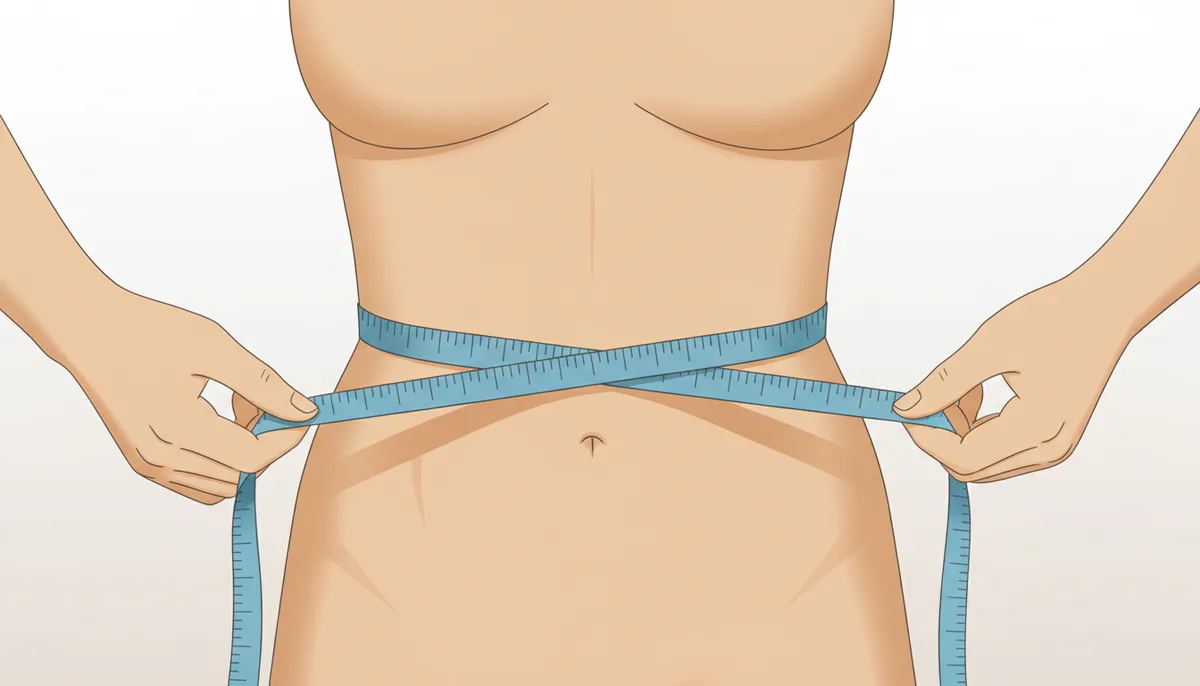
You step on the scale and see a number you like. You plug your measurements into a body fat calculator and get a result that makes no sense. The next day, you do it again and get a completely different percentage, even though nothing has changed. The problem isn't the calculator. It's how you're holding the tape.
Online tools like the CalculatorLine Body Fat Calculator use proven formulas, such as the US Navy method, that are notoriously sensitive to input. A variance of just half an inch on your waist measurement can swing your calculated body fat percentage by one or two points. That’s enough to jump you from a "fitness" category into "average" or vice versa. The goal isn't to find a single, perfect number—it's to establish a consistent, repeatable process so the trend line you see over weeks and months reflects actual change, not measurement error.
Why Your Body Fat Readings Jump (and How to Stop It)
Think of your body fat percentage as a moving target. Your hydration level, the time of day, and even your last meal can cause small, temporary fluctuations in your circumference measurements. The formulas amplify these tiny changes. The US Navy formula, for instance, uses a ratio of your waist and neck (and hips for women) to estimate density. A small error in measuring one of these values gets baked into the calculation.
Your mission is to eliminate the variables you can control. This means measuring under the same conditions every time, using the right tool, and following a precise technique. Consistency beats perfection. If you always measure your waist first thing in the morning, after using the bathroom, and before breakfast, you’re comparing apples to apples, even if the absolute number is off by a fraction. That’s how you see real progress.
The Pre-Measurement Checklist: Setting the Stage for Accuracy
Your first step happens long before you pick up the tape measure. You must standardize your environment. Do this wrong, and you’re adding noise to your data before you even start.
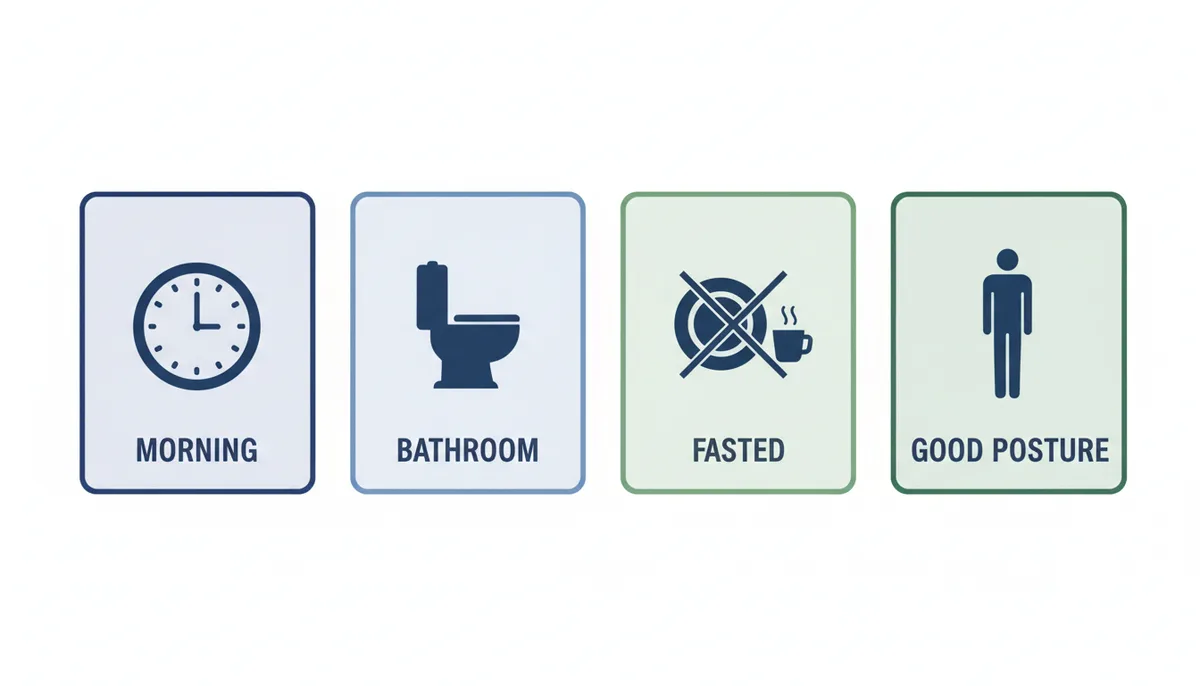
Measure first thing in the morning. Your body is in its most fasted and dehydrated state, which minimizes bloating and water retention that can inflate your measurements. Go to the bathroom first. A full bladder or bowels can easily add an inch to your waist circumference. Wear minimal clothing—ideally, just your underwear—or the same form-fitting clothes each time. Bulky sweatpants or a belt will ruin your hip and waist measurements.
Stand tall on a hard, level surface. Distribute your weight evenly on both feet, relax your shoulders, and let your arms hang naturally at your sides. Don’t suck in your gut or push it out. Breathe normally.
Choosing Your Tools: Not All Tape Measures Are Created Equal
The floppy, cloth tape measure in your sewing kit is your worst enemy. It stretches. Over time, it will stretch more, making your measurements inconsistent and unreliable. You need a tape that gives the same reading every time you use it.
Your best affordable option is a non-stretch, flexible fiberglass tape measure. These are sold specifically as "body measuring tapes" and are rigid enough to resist stretching but flexible enough to contour to your body. For the highest level of consistency, look for a tension-controlled tape, like a Gulick tape. These have a spring-loaded mechanism or a specific sliding handle that applies a fixed, repeatable amount of pressure (usually 4 ounces) every time. This eliminates the biggest variable: how tightly you pull.
| Tape Type | Material | Stretch/Accuracy | Consistency | Cost | Best Use Case |
|---|---|---|---|---|---|
| Cloth Sewing Tape | Cloth/Vinyl | High stretch, poor accuracy | Low (degrades) | $2-5 | Avoid for body measurements |
| Fiberglass Body Tape | Fiberglass | No stretch, good accuracy | High | $5-10 | Reliable standard for home use |
| Tension-Controlled (Gulick) | Fiberglass/Metal | No stretch, fixed tension, excellent accuracy | Perfect | $20-40 | Clinical settings or serious trackers |
How to Pinpoint Your Measurement Sites: A Visual Guide
This is where most guides stop. They tell you "measure your waist" but don't tell you how to find the exact same spot next time. You need to use anatomical landmarks, not guesses.
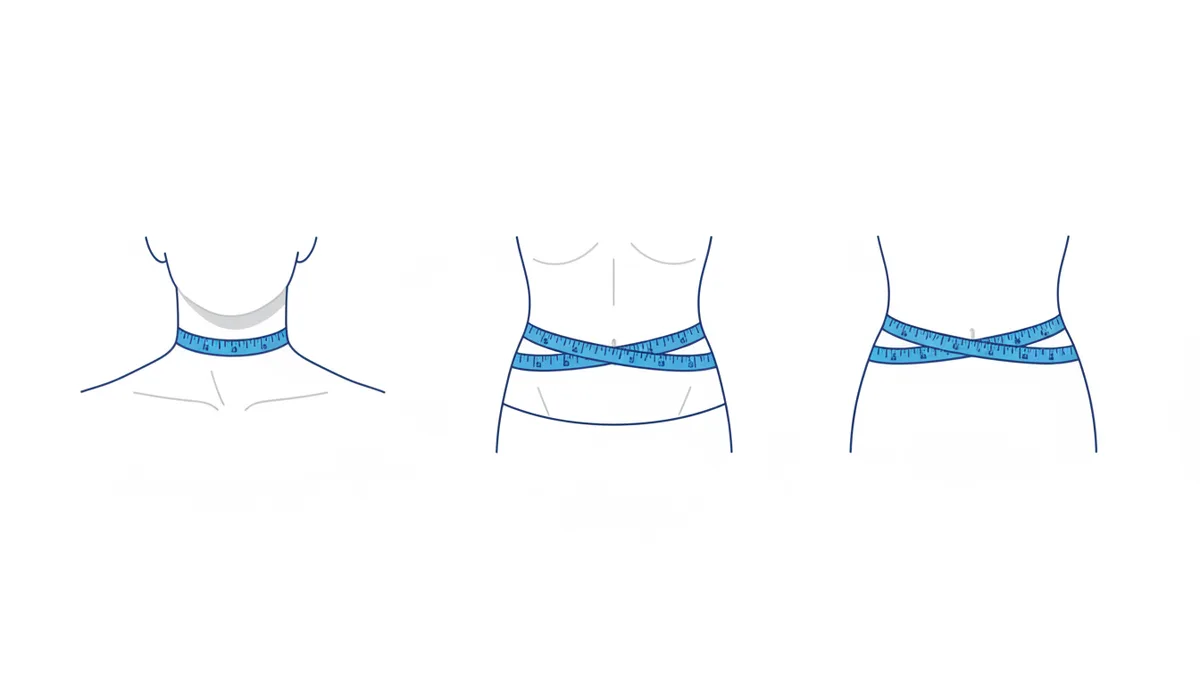
Neck: Find your larynx (Adam's apple). Place the tape just below this prominence, perpendicular to the long axis of your neck. Don't measure over your larynx itself. Ensure the tape is level around your entire neck.
Waist: This is the most common source of error. You must know which standard your calculator uses. The US Navy method specifies the waist measurement be taken at the horizontal level of the navel (umbilicus). However, other standards like the World Health Organization (WHO) use the midpoint between the lowest rib and the top of the hip bone (iliac crest). For calculators like the one on CalculatorLine, which often use the Navy method, use the navel. Place the tape directly on your skin, making sure it's level all the way around your body.
Hips (Women only for Navy method): This is not where the top of your pants sit. It is the maximal circumference of your buttocks. Look at yourself from the side in a mirror to find the very widest point. The tape should be level around your body at this point.
Mastering the Technique: Tape Tension and Breathing
You have the right tool and the right spot. Now, the technique determines everything.
The tape should be snug but not compressing the skin. If the tape is digging in and creating a visible indentation, it's too tight. If it's so loose that it could slide down, it's too loose. With a fiberglass tape, you should be able to fit a finger underneath it comfortably. With a Gulick tape, let the mechanism do the work for you.
Breathing is critical. Do not hold your breath or suck in your stomach. Here is the exact sequence: Take a normal breath in, then exhale fully and relax. Take the measurement at the very end of that exhalation, before you inhale again. This ensures you're not contracting your abdominal muscles, which would give a false low reading.
For the waist and hips, check in a mirror to ensure the tape is perfectly parallel to the floor. A tape that angles up or down in the back will give an incorrect, larger measurement.
Putting It All Together: From Measuring to Logging
Now, execute the entire process. Set up your environment according to the checklist. Using your fiberglass or Gulick tape, take each measurement. Do not just measure once. For each site, take the measurement two or even three times. If the readings are within a quarter of an inch (or half a centimeter) of each other, take the average. If they’re further apart, reassess your landmark and technique and measure again.
Record everything immediately. Don't trust yourself to remember the numbers. Use a log—digital or paper—that captures the date, time, your body weight, and each individual measurement. This data is gold for tracking your progress.
Finally, input your averaged neck, waist, and hip measurements into the CalculatorLine Body Fat Calculator. It will run the numbers through the correct formula (Navy or YMCA) and give you a percentage. Use the provided categories (e.g., Essential Fat, Athlete, Fitness, Average, Obese) as a general guide, but remember that the real value is in the change of that number over time.
| Date | Body Weight (lbs/kg) | Neck (in/cm) | Waist (in/cm) | Hips (in/cm) | Calculated BF% | Notes |
|---|---|---|---|---|---|---|
| 10/26/2023 | 165 lbs | 15.5 in | 34.0 in | — | 18.5% | AM, fasted |
| 11/09/2023 | 163 lbs | 15.5 in | 33.5 in | — | 17.8% | AM, fasted |
| 11/23/2023 | 162 lbs | 15.6 in | 33.0 in | — | 17.2% | AM, fasted |
How Tape Measurements Compare to Other Body Fat Tests
The circumference method isn't the most accurate test in the world, but it is the most practical for tracking changes at home. Its value is in its consistency and accessibility.
Methods like DEXA scans (which uses X-rays) and hydrostatic weighing (underwater weighing) are considered gold standards for accuracy, but they are expensive, inconvenient, and require a clinical setting. Bioelectrical Impedance Analysis (BIA) scales are convenient but highly sensitive to hydration, making day-to-day readings volatile. Skinfold calipers are accurate in expert hands but have a very high learning curve for self-use.
The tape measure method sits in the sweet spot: it's free, you can do it perfectly at home with practice, and when done correctly, it's exceptionally good at showing you whether you're moving in the right direction. It may overestimate body fat in very muscular individuals and underestimate it in older adults, but the trend line remains valid.
| Method | Cost | Accessibility | Accuracy | Best For |
|---|---|---|---|---|
| Circumference (Tape) | Free - $40 | Excellent (Home) | Moderate (Good for trends) | Tracking changes over time at home |
| Skinfold Calipers | $10 - $400 | Moderate (Technique) | Good (with expert) | Trainers, coaches, technique-focused users |
| BIA Scale | $50 - $200 | Excellent (Home) | Low (Volatile) | General wellness trends (use weekly averages) |
| DEXA Scan | $100 - $250 per scan | Poor (Clinic) | Excellent | Getting a precise baseline 1-2 times per year |
A Worked Example: Calculating Your Body Fat Percentage Step-by-Step
Let's walk through a real measurement session for a fictional user named Alex, a 35-year-old man who wants to track his body fat. This isn't about getting a perfect number; it's about demonstrating a repeatable process.
Pre-Measurement: Alex measures on a Tuesday morning at 7:00 AM. He's just woken up, used the bathroom, and hasn't had any food or water yet. He's standing in his underwear on the hardwood floor in his bedroom, with a full-length mirror to his side. He checks his posture: feet together, shoulders relaxed, arms at his sides.
The Tools: He uses a new, non-stretch fiberglass tape measure he bought for this purpose.
Taking the Measurements:
- Neck: He finds his Adam's apple and places the tape just below it, ensuring it's perpendicular to his neck and level all the way around. He exhales normally and takes the reading. He does this three times:
- First try: 15.6 inches
- Second try: 15.5 inches
- Third try: 15.5 inches
- Waist (Navel): He locates his navel and places the tape level around his body at this point. He takes a normal breath, exhales fully, and relaxes his abdomen. At the end of the exhale, he reads the tape. Three tries:
- First try: 34.25 inches
- Second try: 34.5 inches (he notes the tape felt slightly loose this time)
- Third try: 34.25 inches
Calculation: Alex goes to the CalculatorLine Body Fat Calculator. He selects "Male", enters his height (70 inches), and inputs his measurements: Neck: 15.5 in, Waist: 34.25 in. He clicks calculate.
The calculator uses the US Navy formula: % Body Fat = 86.010 × log10(abdomen - neck) - 70.041 × log10(height) + 36.76
Plugging in his numbers: log10(34.25 - 15.5) = log10(18.75) ≈ 1.273 log10(70) ≈ 1.845 % Body Fat = (86.010 × 1.273) - (70.041 × 1.845) + 36.76 % Body Fat ≈ (109.50) - (129.23) + 36.76 = 17.03%
The calculator returns a result of 17.0%, placing him in the "Fitness" category. Alex records this number in his log alongside his measurements and weight. The exact number matters less than what it will be in four weeks when he repeats this identical process.
When the Tape Measure Lies: Common Pitfalls and Body Types
The circumference method makes assumptions about your body's proportions. When your physique falls outside the average, the formula can generate misleading results. Knowing these pitfalls helps you interpret your data smarter.
The Bodybuilder Problem: Imagine a lifter with a 17-inch neck and a 34-inch waist. The Navy formula for men calculates body fat using the difference between the waist and neck. A larger neck measurement actually lowers the final calculated percentage. However, a thick, muscular waist from developed obliques and a strong core will increase it. For a very muscular person, these opposing distortions mean the formula can either underestimate or overestimate true body fat, depending on their unique proportions. However, if their waist measurement shrinks from 34 inches to 33 inches while their neck stays the same, the drop in calculated body fat percentage still accurately reflects a positive change in composition.
The Pear-Shaped and Apple-Shaped Dilemma: The formulas are calibrated on populations. For women who are pear-shaped (carrying more fat subcutaneously on hips and thighs), the Navy method, which includes the hip measurement, is generally accurate. For apple-shaped individuals (carrying more visceral fat around the abdomen), the formula might actually underestimate health risk. A large waist circumference is a well-established risk factor for cardiovascular disease and diabetes, independent of overall body fat percentage. If your waist measurement is disproportionately high, pay more attention to that absolute number than to the calculated body fat percentage. Health organizations commonly cite a waist circumference over 35 inches for women and 40 inches for men as a threshold for increased health risk.
The Post-Pregnancy and Weight-Loss Caveat: After significant weight loss or pregnancy, loose skin can confound measurements. The tape measure cannot differentiate between skin and subcutaneous fat. You may pull the tape snug against what feels like a soft roll, but it could be a combination of fat and empty skin. This will result in an overestimation of your true body fat. In this case, the method is less reliable for an absolute number, but the trend can still be valid if the skin remains a constant factor. Focusing on the waist measurement itself (and trying to reduce it) becomes a more relevant goal than the calculated percentage.
The key is to use the tool for what it's good for: tracking relative change. If your number is moving in the direction you want, your process is working. If the number seems wildly off based on your appearance and performance, trust the mirror and how your clothes fit more than the calculator's output. The tape measure is a servant, not a master.
Frequently Asked Questions
Can I measure myself accurately, or do I need a partner?
You can do it yourself, especially with a mirror to check that the tape is level for your waist and hips. A partner is helpful for ensuring perfect placement and tension on the first try, particularly for the hip measurement, but it's not a requirement for accuracy.
How often should I measure my body fat percentage?
Measure once every 2 to 4 weeks. Your body needs time to undergo meaningful composition changes. Measuring daily will only show you meaningless fluctuations from water weight and measurement variance, which leads to frustration.
Why did my body fat percentage go up when my weight went down?
Since the Navy formula doesn't use body weight in its calculation, this points to a change in your circumferences or an error in measurement. Your waist measurement may have increased relative to your neck (or hips for women) due to bloating, water retention, or inconsistent tape placement. While losing muscle mass can change your body's shape, the most common causes for this discrepancy are measurement variance or natural daily fluctuations. Re-measure following the standardized protocol before concluding your body composition has negatively changed.
Is the US Navy body fat formula accurate for women?
The formula is an estimation tool calibrated on large population studies. It uses a different equation for women that incorporates the hip measurement to account for typical fat distribution patterns. Its accuracy for any individual depends entirely on the precision of the measurements entered and how closely her body type matches the population average. It is a useful tool for tracking trends when measurements are taken consistently.
Does this method work if I'm very muscular?
It has limitations. The formulas are based on population averages. If you have a very high degree of muscle mass (e.g., a bodybuilder), the equation may overestimate your true body fat percentage because it interprets your larger neck and possibly larger waist (from core muscles) as fat. However, it remains an excellent tool for tracking relative changes in your physique over time.
What is a healthy body fat percentage?
Healthy ranges are age and sex-specific. Generally, for men, 10-20% is considered fit, and for women, 18-28%. Organizations like the American Council on Exercise provide detailed charts breaking down categories from essential fat to obese. Remember that these are general guidelines, and optimal health is influenced by many other factors.
Sources
- U.S. Army Publishing Directorate — The home of Army Regulation 600-9, 'The Army Body Composition Program', which provides an alternative, official military standard for body fat measurement via tape measure.
- World Health Organization (WHO) — Provides standardized protocols for anthropometric measurements, including the specific anatomical landmark for measuring waist circumference for health risk assessment.
- American Council on Exercise (ACE) — An authoritative source for body fat percentage norms by age and fitness level, and for general information on the pros and cons of different body composition assessment methods.