A Calculator Result Checklist Before You Use the Number in a Real Decision

Last month, my neighbor took out a mortgage based on a monthly payment calculation that looked perfect. Six months in, she discovered her actual payment was $400 higher. The calculator wasn't wrong—it calculated principal and interest flawlessly. It just didn't mention property taxes, homeowners insurance, or PMI. That $400 difference? The cost of trusting a number without validating what it actually represents.
Every day, people make life-changing decisions based on calculator outputs: signing for loans, planning retirement, setting calorie targets. The math might be perfect, but perfect math on incomplete assumptions leads to real consequences. A 2% difference in your assumed investment return could mean working five extra years. A mortgage calculator that ignores taxes could qualify you for a house you can't actually afford.
This isn't about calculator errors—most online calculators perform their math correctly. It's about the gap between what a calculator computes and what your decision actually requires. That gap hides in unstated assumptions, missing inputs, and misunderstood outputs. This checklist will teach you to spot those gaps before they cost you.
Why Can a 'Correct' Calculator Result Still Lead to a Bad Decision?
The computer science principle "Garbage In, Garbage Out" (GIGO) applies perfectly to online calculators. Feed a mortgage calculator an annual rate of 6% when it expects a monthly decimal (0.005 for 6% annual), and you'll get a payment that's mathematically correct but financially catastrophic. The calculator did its job—you gave it the wrong instructions.
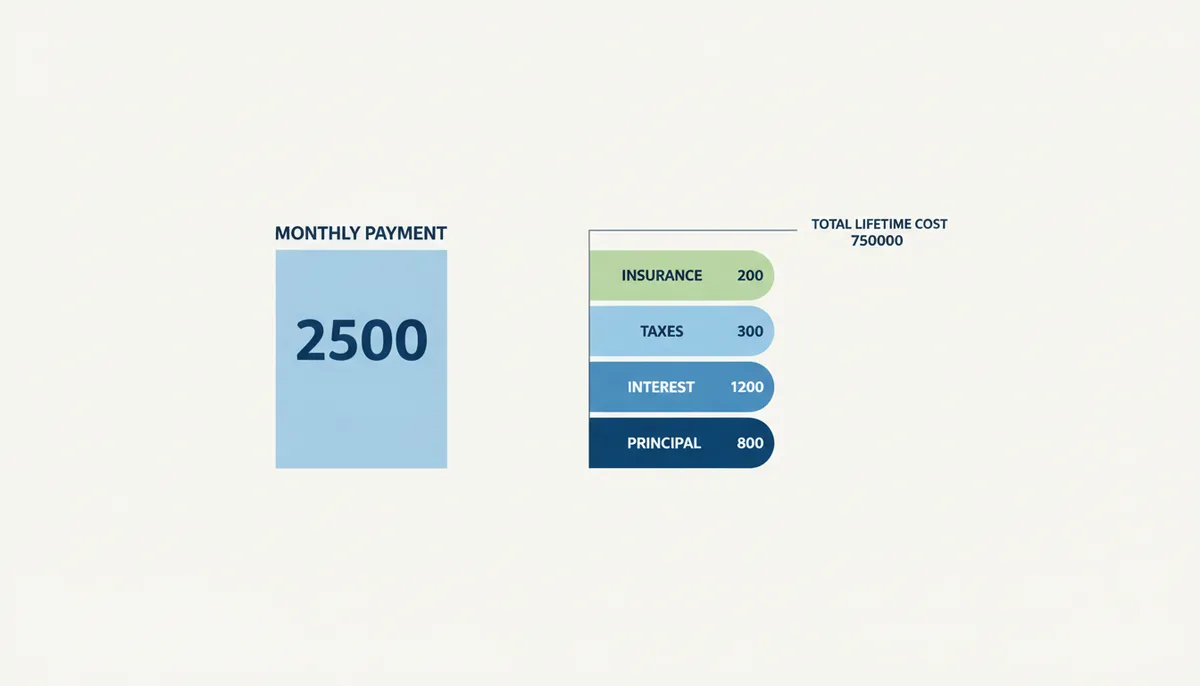
But GIGO is just the start. Even with perfect inputs, a calculator can mislead through what it doesn't calculate. A mortgage calculator might compute your principal and interest payment at $2,000 monthly. Technically correct. But your actual PITI payment (Principal, Interest, Taxes, Insurance) could be $2,600. The missing $600? That's the cost of incomplete scope.
Take investment calculators. You input $500 monthly contributions at 8% annual return. The calculator shows you'll have $1.2 million in 30 years. What it doesn't show: that 8% assumption comes from historical stock market averages that include multiple crashes and recoveries. It doesn't account for the 2% annual fee your actively managed fund charges. It ignores taxes on gains. Your actual result might be half that rosy projection.
The most dangerous calculators aren't the ones that calculate wrong—they're the ones that calculate only part of what matters. A BMI calculator will accurately place you in the "overweight" category at 27 BMI. What it won't tell you is that professional athletes routinely score as "obese" because muscle weighs more than fat. The formula works perfectly. The interpretation without context doesn't.
What Are the Core Components of Any Calculator's Result?
Every calculator follows the same three-stage process. You provide inputs. The calculator applies its model (the "black box"). You receive outputs. Understanding what happens at each stage is your first defense against misleading results.
Your inputs are everything you type in: loan amount, interest rate, body weight. These seem straightforward until you realize that "interest rate" could mean the advertised rate, the APR, or the effective rate after compounding. A seemingly simple field like "loan term" could want years or months. Get this wrong, and a 30-year mortgage becomes a 30-month calculation.
The black box contains the calculator's formula and embedded assumptions. A mortgage calculator uses an amortization formula—that's transparent. What's hidden are decisions like: Does it assume monthly compounding or daily? Does it include PMI for down payments under 20%? Does it factor in typical closing costs? These assumptions dramatically affect real-world accuracy, yet most calculators never state them.
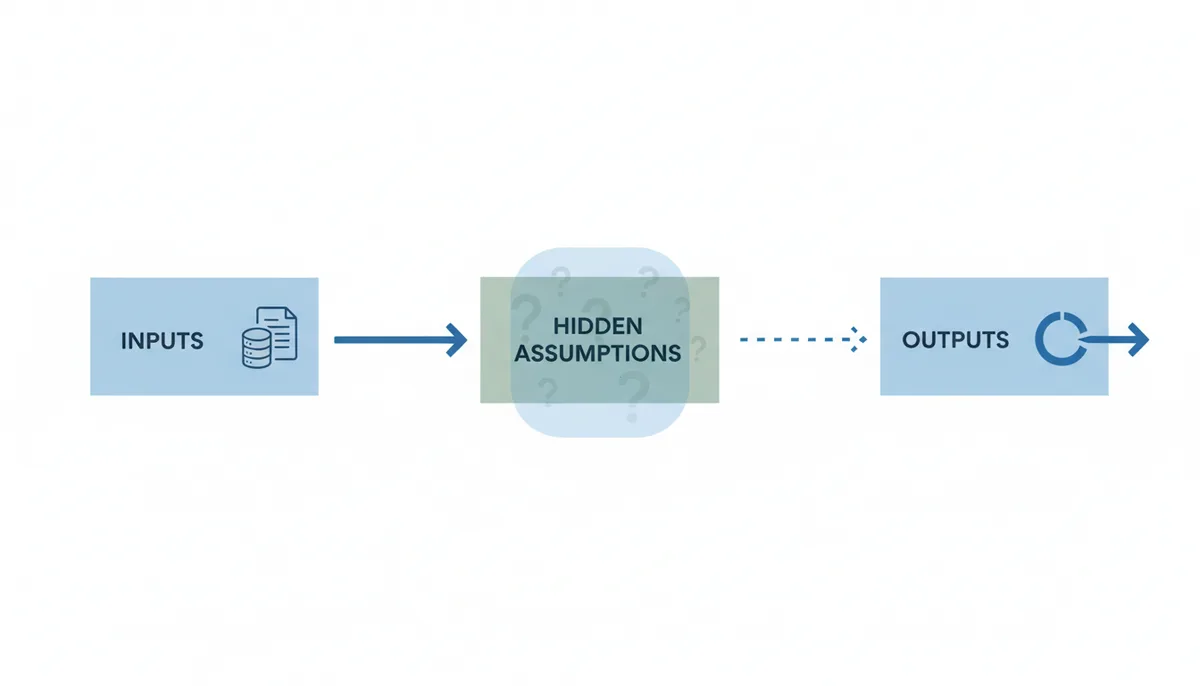
The outputs extend beyond the big number at the top. Yes, you see "$2,500/month," but the valuable outputs often hide below: the amortization schedule showing how each payment splits between principal and interest, the total interest paid over the loan's life, the payoff date if you add $100 monthly. These secondary outputs reveal the true cost of your decisions.
Consider a currency converter. The primary output shows 1 USD = 0.92 EUR. The critical secondary information? Whether that's the mid-market rate or includes fees, the timestamp of the rate, and any minimum transaction amounts. Without this context, you might budget a trip based on a rate you'll never actually receive.
How Do I Systematically Vet My Inputs?
Input errors kill more calculations than broken formulas. Start with units—the silent destroyer of accurate results. Interest rates are the worst offender. A 6% annual percentage rate equals 0.06 as an annual decimal, which becomes 0.5% monthly (0.005 as a monthly decimal). Enter 6 when the calculator expects 0.005, and your $300,000 mortgage payment calculation will be wildly wrong.
Time periods create similar havoc. A loan calculator asking for "term" might want months or years—rarely specified clearly. Enter 30 (years) where it expects 360 (months), and you'll calculate payments for a 2.5-year loan. Auto loan calculators are notorious for this ambiguity.
Source quality matters as much as format. That interest rate you're entering—where did it come from? The bank's advertisement shows a 6.75% note rate. The loan estimate shows 7.1% APR, which includes certain fees and costs. Your pre-approval letter mentions 6.9% with points. For calculating your monthly principal and interest payment, use the note rate (6.75%). For comparing total loan costs between lenders, use the APR. But remember that neither includes property taxes, insurance, or HOA fees—those appear elsewhere in your loan estimate.
Stress-test every calculation by running three scenarios: your expected case, a worse case (rates rise 0.5%, your income drops 10%), and a best case (you get a raise, rates fall). If small input changes cause dramatic output swings, you've identified a decision that's sensitive to factors you might not control. A retirement plan that only works if markets return exactly 8% annually isn't a plan—it's a hope.
For health calculators, input freshness matters. Using your weight from six months ago in a TDEE calculator might seem harmless, but a 10-pound difference changes your daily calorie target by 50-100 calories. Over a year, that's 18,000-36,000 calories—the equivalent of 5-10 pounds of fat loss or gain.
How Can I Sanity-Check the Calculator's 'Black Box'?
The quickest validation comes from a back-of-the-envelope calculation. For a mortgage, multiply the loan amount by the interest rate, divide by 12. This gives you the interest-only payment. Your actual payment must be higher (it includes principal), but not dramatically so for a 30-year loan. If a $300,000 loan at 7% shows a payment under $1,750 (the interest-only amount), something's wrong.
Investment calculations deserve similar scrutiny. The Rule of 72 says your money doubles in (72 ÷ return rate) years. At 8% return, that's 9 years. If a calculator shows your $10,000 growing to $50,000 in 15 years at 8%, it's claiming 5x growth when the rule suggests 3.5x maximum. That's your cue to check for hidden assumptions like additional contributions.
What a calculator doesn't ask reveals its limitations. A mortgage calculator that never asks about property taxes, HOA fees, or insurance isn't calculating your housing payment—it's calculating a fictional number. A BMI calculator that doesn't ask about age, sex, or activity level applies the same formula to a 20-year-old athlete and a 70-year-old retiree.
Run the same calculation through multiple calculators, especially one from a regulatory source. The CFPB's mortgage calculator includes fields for taxes, insurance, HOA fees, and PMI. If it shows a payment $400 higher than a basic web calculator, you've discovered $400 worth of hidden costs the simple calculator ignored.
| Calculator Feature | Basic Web Calculator | CFPB Calculator | What's Missing Can Cost You |
|---|---|---|---|
| Principal & Interest | Yes | Yes | — |
| Property Taxes | No | Yes (estimated) | $200-500/month |
| Homeowners Insurance | No | Yes (estimated) | $100-300/month |
| PMI (if applicable) | Rarely | Yes (automatic) | $100-400/month |
| HOA Fees | Never | Yes (optional) | $0-500/month |
| Total Difference | — | — | $400-1,700/month |
How Should I Interpret the Outputs Beyond the Headline Number?
The monthly payment grabs attention, but the total interest paid tells the real story. On a $300,000 mortgage at 7% for 30 years, you'll pay $418,527 in interest—more than the original loan. Suddenly, that 15-year option at a slightly higher payment saves you $262,000. The headline number hides the lifetime cost.
Look for rate context on every currency or crypto converter. That perfect 1.31 USD/EUR rate? It's probably the mid-market rate—the wholesale price banks pay. Your credit card adds 2-3%. ATMs add flat fees. Money transfer services take another cut. By the time you actually convert $1,000, you might receive €720 instead of the €763 the calculator showed.
Investment projections require the deepest skepticism. A calculator showing your retirement account growing to $2 million makes assumptions about: consistent returns (markets don't work that way), no withdrawals (emergencies happen), steady contributions (job loss exists), and often ignores inflation entirely. The projection is useful for understanding compound interest, not for planning your retirement date.
BMI results need context from the CDC categories: underweight (<18.5), normal weight (18.5-24.9), overweight (25-29.9), and obese (≥30). But also understand the limitations. The formula is BMI = weight(kg) / height(m)². It can't distinguish between a bodybuilder at 28 BMI with 8% body fat and someone with the same BMI but 30% body fat. For athletes or elderly individuals, body fat percentage or waist circumference provides better health insights.
Examine time-based visualizations carefully. An amortization schedule reveals that your first mortgage payment might be 80% interest, 20% principal. By year 15, it flips. This explains why extra principal payments early in the loan save dramatic amounts—you're avoiding decades of interest on that money.
What Is the Final, Pre-Decision Checklist for My Specific Goal?
Different decisions require different validation steps. A mortgage commitment needs deeper verification than a quick currency conversion. Here's your domain-specific checklist for major calculator types:
| Validation Step | Mortgage/Loan | Investment | Health (BMI/Calories) | Currency/Crypto |
|---|---|---|---|---|
| Verify Input Units | APR vs. rate, years vs. months | Annual vs. monthly contributions | Pounds vs. kg, feet/inches vs. cm | Direction of conversion (from/to) |
| Identify Hidden Assumptions | PITI vs. P&I only, PMI threshold | Tax treatment, fees ignored | Formula version (which BMR equation) | Mid-market vs. retail rate |
| Check Required Inputs | Down payment %, closing costs | Initial balance, time horizon | Activity level, age, sex | Transaction fees, minimums |
| Review Secondary Metrics | Total interest, amortization schedule | Inflation adjustment, final purchasing power | Healthy weight range, BMR/TDEE | Spread percentage, update frequency |
| Reality-Check Output | Payment vs. income (28% rule) | Historical returns (7-10% stocks) | Calorie targets (min 1200-1500) | Compare to bank/card statement |
| Consider Sensitivity | Rate changes, job loss | Market downturns, inflation | Metabolism variation (±15%) | Volatility (crypto especially) |
For mortgages and loans, your checklist must distinguish between the advertised rate and APR. The APR includes origination fees, points, and other charges, giving the true cost. Verify whether the calculator uses P&I (principal and interest only) or PITI (including taxes and insurance). Check if PMI applies—it kicks in automatically for down payments under 20%, adding $100-400 monthly.
Investment calculations need the harshest scrutiny. Question the assumed return rate—historical stock returns average 7-10% annually, but with huge variation. A calculator assuming 12% is selling dreams. Check if returns are nominal or inflation-adjusted. A 7% nominal return with 3% inflation means 4% real growth. Verify if taxes on gains and annual fund fees are included—a 2% annual fee turns an 8% return into 6%.
For health metrics, confirm which formula is used. Calorie calculators might use Mifflin-St Jeor (more accurate for sedentary individuals) or Harris-Benedict (older, tends to overestimate). The difference can be 200+ calories daily. Activity multipliers range from 1.2 (sedentary) to 1.9 (very active), but people consistently overestimate their activity level. When in doubt, choose one level lower.
Currency and crypto conversions require timing awareness. Rates change constantly—that screenshot from this morning might be outdated by afternoon. For crypto especially, the spread between buy and sell prices can exceed 2%. Add network fees for crypto (which can be $20-100 per transaction during busy periods), and your effective rate might be 5-10% worse than displayed.
FAQ
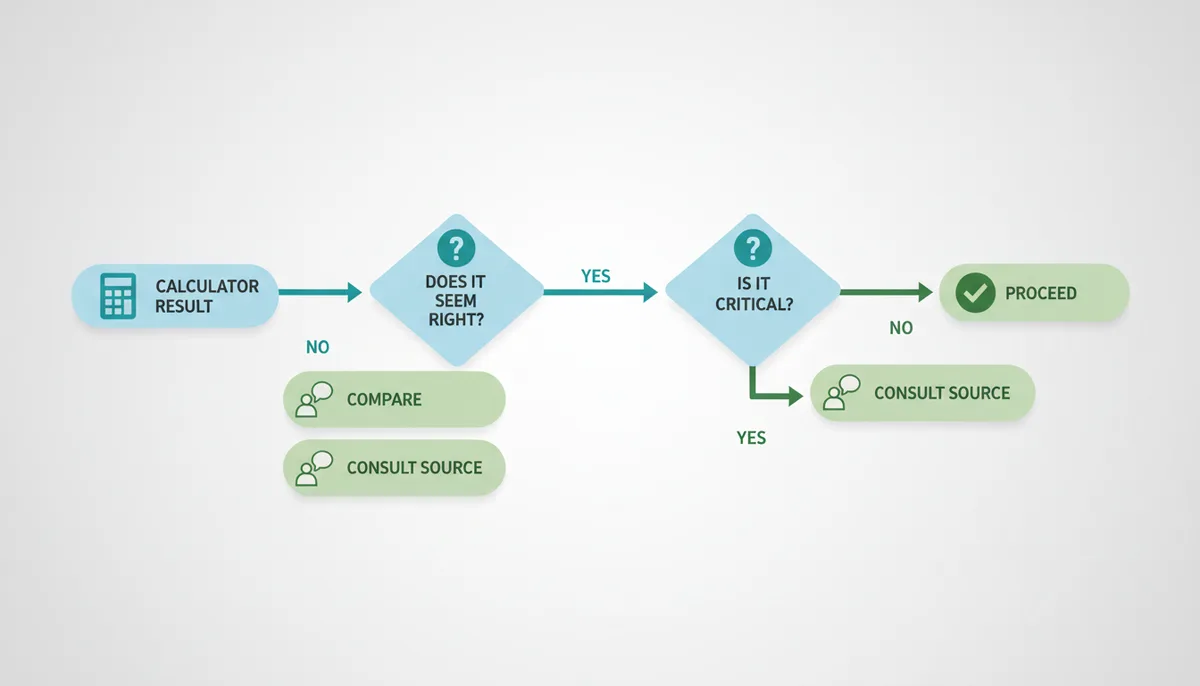
If two calculators give me different results, which one is right? The difference itself is the most valuable information. It reveals a hidden assumption or fee in one of the calculators. Investigate why they differ—the more comprehensive calculator that asks for more details is usually providing the more realistic result.
How can I account for inflation in a long-term investment calculator? Look for a setting for 'inflation-adjusted' or 'real' returns. If it's not available, manually subtract the expected inflation rate from the annual return rate (e.g., a 7% return with 3% inflation becomes a 4% real return) for a more realistic projection.
Are calculators on bank or lender websites more trustworthy? They are usually accurate for the specific products they offer but may be designed to present a favorable result. Always compare their output with an independent calculator to ensure all costs and fees are visible.
My BMI result is 'overweight,' but I have a lot of muscle. Is it wrong? Yes, this is a known limitation. BMI is a population-level tool that cannot distinguish between fat and muscle mass. For athletic individuals, a body fat percentage calculator provides a more accurate assessment of health.
Why doesn't the currency converter's result match the rate my bank gives me? Online converters typically show the 'mid-market rate,' which is the wholesale price without fees. Banks and credit card companies add a 'spread' or fee to this rate, which is why the rate you actually get is less favorable.
How far into the future can I realistically project with an investment calculator? Use long-term (20+ year) projections to understand concepts like compound interest, not as a guaranteed prediction. The further out the projection, the more sensitive it is to your assumed rate of return, making it highly speculative.
What Real-World Factors Do Calculators Almost Never Include?
Imagine a calculator shows a $1,500 monthly mortgage payment you can afford. Three months after moving in, you might be struggling. The calculator wasn't wrong—but it knew nothing about the $300 monthly commute from your new suburb, the $200 higher utility bills for a house versus your apartment, or the $150 monthly lawn service the HOA requires. Calculators compute math, not life.
Transaction timing destroys more budgets than wrong calculations. That investment calculator assumes you contribute $500 on the first of every month like clockwork. Reality: your freelance income arrives irregularly, you skip December for holiday expenses, and your car repair in March takes three months' contributions. A 20% return means nothing if you could only invest 60% of what you planned.
Market friction—the costs of actually executing what the calculator suggests—hides everywhere. Your currency converter shows saving $200 by paying for your vacation rental in euros instead of letting them convert. But your bank charges $35 for international wires, the recipient bank takes €25, and you lose another 1% on a worse exchange rate than displayed. Your $200 savings just became a $10 loss.
For loans, the human factor changes everything. That 6.5% rate assumes excellent credit. Miss one payment during underwriting, and it jumps to 7.2%. The calculator assumes you'll never refinance (losing thousands in fees), never pay late (triggering penalties), and never need to sell early (eating transaction costs). It assumes your income stays stable—but job changes, industry downturns, and life events regularly disrupt income.
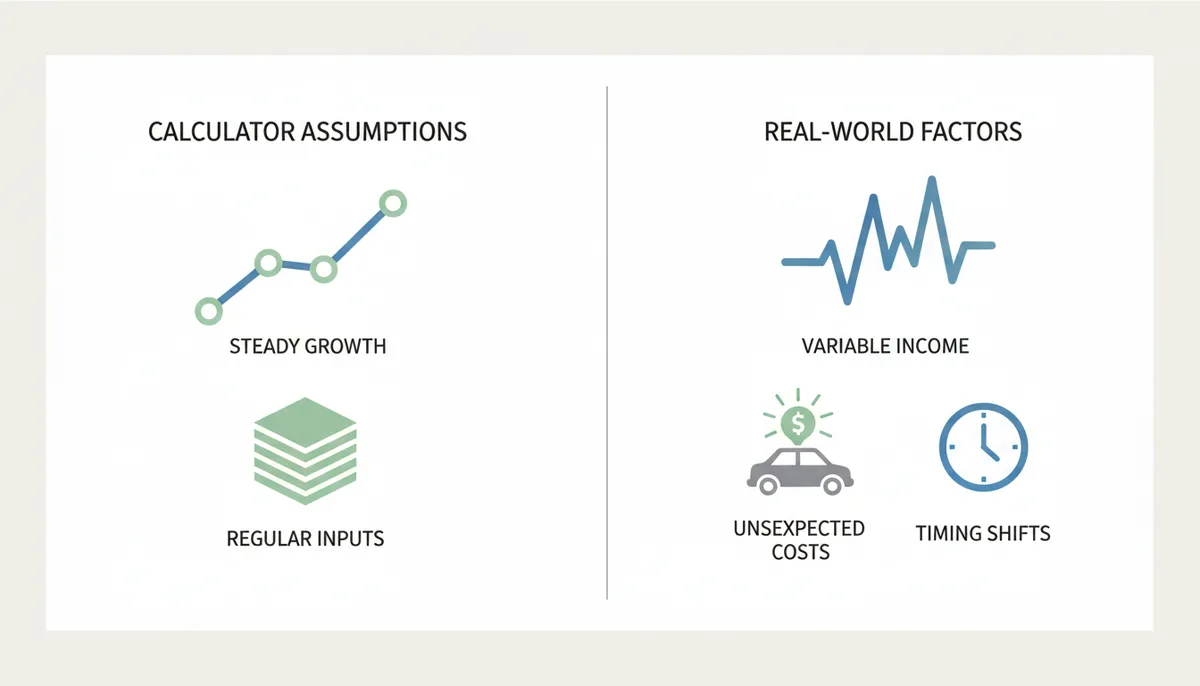
Health calculators particularly fail at behavioral reality. Your TDEE calculation says you burn 2,400 calories daily. It assumes your "moderate activity" means exactly what the formula expects—not your interpretation. It assumes consistent activity, but seasonal changes affect most people's movement patterns. It can't know if your medications affect metabolism or that your desk job involves more sitting than typical office work.
Tax implications remain calculators' biggest blind spot. Investment returns shown are almost always pre-tax. That million-dollar retirement projection? After taxes on withdrawals, it might be $750,000. State taxes vary from 0% to 13%. Early withdrawal penalties take another 10%. The calculator shows growth—you live on what's left after the government's share.
How Do I Build My Own Reality-Check Model?
The best validation comes from building a simplified version yourself—not to replace the calculator, but to understand what it's actually doing. Start with the basic relationship, then add complexity until you match the calculator's result. The gaps you find are the hidden assumptions.
Take mortgage calculations. The basic monthly payment formula is: M = P[r(1+r)^n]/[(1+r)^n-1], where P is principal, r is monthly rate, and n is number of payments. Terrifying? Build it up instead. Start simple: a $300,000 loan at 6% yearly (0.5% monthly) means $1,500 in interest the first month. Over 360 months, that's $540,000 in interest if you paid interest-only. Your actual payment must be less than $2,000/month (principal plus interest-only would be $2,333).
For investments, start with simple growth. $10,000 growing at 8% becomes $10,800 after one year. After two years: $11,664. Notice the extra $64? That's compound interest—earning returns on your returns. Build a spreadsheet: Year 1 = Principal × 1.08. Year 2 = Year 1 × 1.08. Drag the formula down 30 rows. Now add monthly contributions, then subtract fees. When your model matches the calculator, you understand exactly what it assumes.
Create your own reality-adjusted model. Take the calculator's output and add real-world frictions. Mortgage payment of $2,000? Add property tax ($300), insurance ($150), maintenance reserve ($200), and utilities increase ($150). Your true housing cost: $2,800. Can you still afford it?
| Calculator Type | Basic Formula Component | Reality Adjustments to Add | Typical Impact |
|---|---|---|---|
| Mortgage | Principal + Interest | Taxes, Insurance, Maintenance, PMI | +25-40% to payment |
| Investment | Principal × (1 + rate)^years | Fees, Taxes, Inflation, Gaps in contributions | -30-50% final value |
| Retirement | FV of annuity formula | Inflation, Healthcare costs, Tax on withdrawal | -40-60% purchasing power |
| Calorie/Weight | BMR × Activity factor | Metabolic adaptation, Tracking errors, Water weight | ±15-25% variation |
The insight comes from understanding sensitivity. Change your mortgage rate by 0.5%—how much does the payment jump? If it's $200, and rates are volatile, you need $200/month buffer. Reduce your investment return assumption by 2%—how many extra years to retirement? If it's five years, you can't count on optimistic projections.
This exercise reveals which variables matter most. For mortgages, it's the interest rate and loan term. For investments, it's the return rate and time horizon. For weight loss, it's the accuracy of your food tracking. Focus your validation on the variables that swing the outcome most dramatically.
Conclusion
Trust in calculator results isn't binary—it's a spectrum based on how thoroughly you validate inputs, understand assumptions, and interpret outputs. The perfect calculation with incomplete scope helps nobody. The rough estimate that captures all costs beats precise math on partial data.
Your validation effort should match your decision's weight. Quick currency conversion? Verify the rate is current and includes fees. Mortgage calculation? Run the full checklist, compare multiple sources, and stress-test the scenarios. The ten minutes spent validating could save you from years of financial strain or months of ineffective diet planning.
Remember: calculators are tools, not oracles. They process the numbers you provide through the formulas they're programmed with. The wisdom lies in knowing what to input, which calculator to trust, and how to interpret what comes out. Use this checklist, and you'll make decisions based on complete information—not just correct arithmetic.
Sources
- Consumer Financial Protection Bureau (CFPB) — The definitions and components of mortgage calculations, including PITI, PMI, and the difference between interest rate and APR.
- U.S. Securities and Exchange Commission (SEC) — The principles of compound interest, the impact of fees on investment returns, and the importance of realistic rate-of-return assumptions.
- Centers for Disease Control and Prevention (CDC) — The official definitions of BMI, its categories, and its stated limitations, particularly regarding athletes and different body compositions.
- The Academy of Nutrition and Dietetics — The scientific basis for calorie estimation formulas like the Mifflin-St Jeor equation and the concept of Total Daily Energy Expenditure (TDEE).
- International Organization for Standardization (ISO) — The standard for three-letter currency codes (e.g., USD, EUR) used in financial transactions and currency converters.