How to Check a Calculator Result by Estimating It First
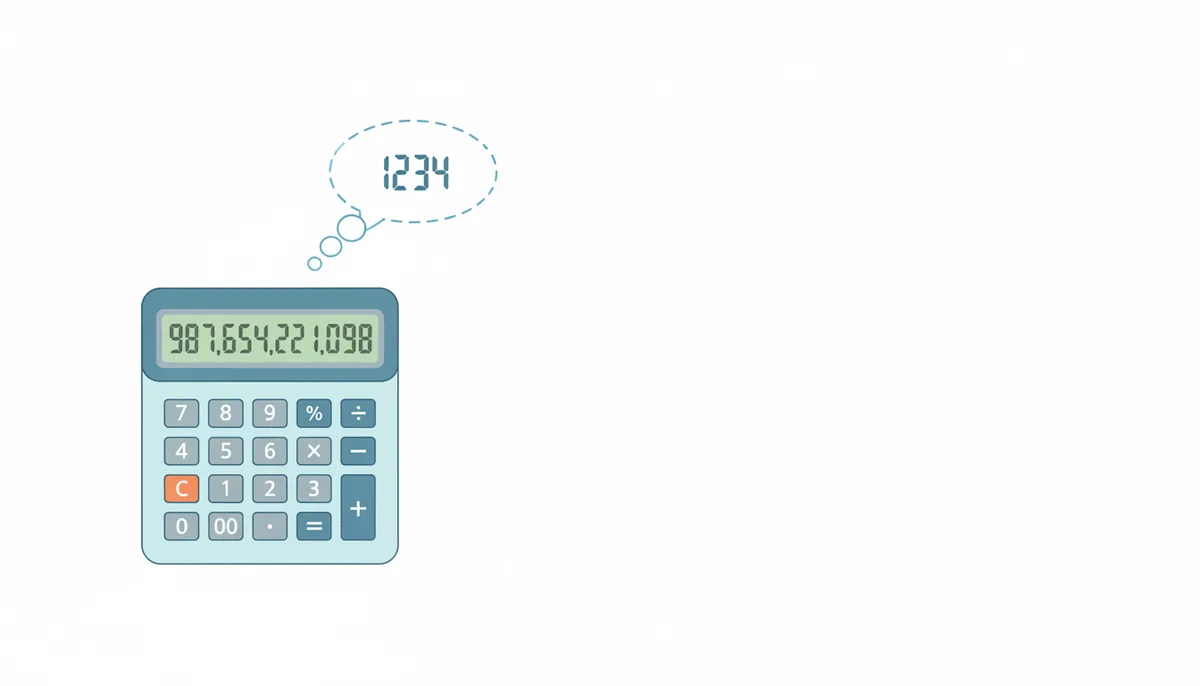
You’ve just finished typing a complex series of numbers into your mortgage calculator. You hit "=" and a result appears: $2,450.52. For a split second, your gut twists. You were expecting something closer to $1,800. You don't know if the calculator is broken, or if you simply typed "30 years" instead of "15," or if you accidentally added an extra zero to the loan principal. This hesitation is the most important moment in using any digital tool.
The problem isn't the calculator. Modern tools like those on CalculatorLine.com are mathematically precise. The problem is "Garbage In, Garbage Out" (GIGO). A calculator is a high-speed engine that will happily drive you off a cliff if you give it the wrong directions. If you enter a decimal in the wrong place or swap a monthly interest rate for an annual one, the machine will provide a perfectly accurate answer to a question you didn't actually ask.
Learning to check a calculator result by estimating isn't about becoming a mathematician. It is about building a mental safety net. You aren't trying to replicate the precision of the machine; you are trying to verify the scale of the answer. You are looking for the "sanity check"—the quick, low-effort mental math that ensures your result is in the right neighborhood before you make a life-altering decision based on it.
The Core Techniques: Rounding, Grouping, and Simplifying
If you try to do exact math in your head, you will fail. The goal of estimation is to deliberately introduce "errors" that make the numbers friendly. We do this through rounding and simplification. When you round, you are trading precision for speed, which is a trade you should make every single time you want to verify a result.
The strategy changes depending on the operation you are performing. For addition and subtraction, you want to round numbers in ways that balance each other out. If you round one number up, try to round the next one down. This prevents your estimate from drifting too far in one direction.
For multiplication and division, you can be more aggressive. Rounding both numbers to the nearest "clean" value (like 10, 50, or 100) is usually enough to catch a massive mistake.
Consider a simple grocery trip. You have three items: $4.89, $11.15, and $7.99. If you try to add these precisely in your head, you might stumble. If you round them to the nearest dollar—$5, $11, and $8—you instantly see the total is roughly $24. If your calculator outputted $240.00, your "rounding" check would immediately flag a misplaced decimal.
| Operation | Original Calculation | Simplified Estimation | Why It Works |
|---|---|---|---|
| Addition | 1,482 + 3,129 | 1,500 + 3,100 | Rounding one up and one down keeps the sum stable. |
| Subtraction | 985 - 212 | 1,000 - 200 | Large, round numbers make distance easy to see. |
| Multiplication | 1,482 × 21 | 1,500 × 20 | Using multiples of 10 or 100 simplifies the logic. |
| Division | 4,150 / 52 | 4,000 / 50 | Finding a "clean" divisor is the priority here. |
Finding the Ballpark: Order of Magnitude and Powers of 10
Sometimes, numbers are too large or too small to round into simple integers. In these cases, you should use "order of magnitude" estimation. This is a fancy way of saying: "How many zeros are in this number?"
An order of magnitude error is the most dangerous mistake you can make. It is the difference between a $5,000 loan and a $50,000 loan. Most human errors in data entry involve moving a decimal point one or two places to the left or right. To catch this, don't look at the digits; look at the scale. Ask yourself: Is this answer in the hundreds, the thousands, or the millions?
You can do this by converting numbers to their nearest power of 10. If you are multiplying 8,500 by 2,000, don't try to do the math. Recognize that 8,500 is roughly $10^4$ and 2,000 is roughly $10^3$. Therefore, your answer must be in the neighborhood of $10^7$ (10,000,000). If your calculator says 17,000,000, you're on the right track. If it says 170,000, you've misplaced a decimal.

Estimating for Financial Calculators: Mortgages, Loans, and Investments
Financial calculations are where estimation errors become expensive. A mistake in a mortgage calculation can lead to an entire year of overpaying or a fundamental misunderstanding of your debt capacity.
For Mortgages: You can estimate your monthly principal-and-interest (P&I) payment by using a standardized rate per $100,000 borrowed. Because interest rates and loan terms change, use the following table as a quick mental guide for a standard 30-year fixed-rate mortgage:
| Interest Rate | Monthly P&I per $100,000 |
|---|---|
| 4% | ~$478 |
| 6% | ~$600|
| 8% | ~$734
If you are looking at a $400,000 mortgage at 6%, your mental anchor for principal and interest should be around $2,400. Crucially, if your mortgage calculator includes property taxes, homeowners insurance, HOA fees, or Private Mortgage Insurance (PMI), the result will be significantly higher than this estimate. If your calculator says $3,500, that makes sense; if it says $800, you have likely entered the wrong term length or interest rate.
For Investments: When using an investment calculator to project future value, use the "Rule of 72." This is a mental shortcut to find out how long it takes for your money to double. Divide 72 by your expected annual interest rate. For example, at a 6% return, your money doubles every 12 years ($72 / 6 = 12$). If your investment calculator says your money will triple in 4 years at a 6% rate, you know the math is wrong.
For Loans: When calculating a personal or auto loan, estimate the total interest by looking at the annual cost. If you take a $20,000 loan at a 5% APR for 4 years, you are paying roughly $1,000 in interest per year. While amortization means you pay less interest as the principal drops, a quick "back-of-the-envelope" estimate tells you the total interest should be a bit less than $4,000. If the calculator says $15,000, check your interest rate input immediately.
| Scenario Goal | Key Calculator Inputs | Estimation Rule of Thumb | Estimated Answer | Actual Calculator Answer |
|---|---|---|---|---|
| Monthly Mortgage | $300k Loan, 6% Rate, 30yr | $600 per $100k | $1,800 | $1,798.65 |
| Investment Growth | $10k, 8% Return, 10yrs | Rule of 72 (doubles in 9yrs) | ~$21,000 | $21,589.25 |
| Auto Loan Interest | $30k Loan, 5% APR, 5yrs | 5% of $30k = $1,500/yr | ~$4,000 | $3,975.12 |
Sanity-Checking Health & Fitness Calculators: BMI, Calories, and Body Fat
In health and fitness, the "correct" answer is often a range rather than a single point. This means your estimation isn't looking for a perfect match, but for a biological impossibility. If a BMI calculator tells a 6'0" person weighing 150 lbs that they are "Class III Obese," the calculator hasn't failed—the user has.
For BMI: Use standard benchmarks. You know that a height of 180cm and a weight of 80kg is a relatively healthy, "normal" weight. If you enter similar numbers and get a result that suggests you are extremely underweight or severely overweight, you have likely swapped your units. Check if you entered height in inches when the calculator expected centimeters, or pounds when it expected kilograms.
For Calorie Calculators (TDEE): Use the "10-calorie rule" for a quick BMR (Basal Metabolic Rate) estimate. A very rough baseline is that your body burns approximately 10 calories per pound of body weight just to exist. If you weigh 180 lbs, your BMR is roughly 1,800 calories. To find your TDEE (Total Daily Energy Expenditure), add a multiplier for activity. If you are sedentary, multiply by 1.2; if you are active, use 1.5. For our 180 lb person, the estimate is $1,800 \times 1.2 = 2,160$ calories. If the calculator says 5,000 calories, you’ve likely over-selected your activity level.
Working Backwards: Using the Answer to Check Your Inputs
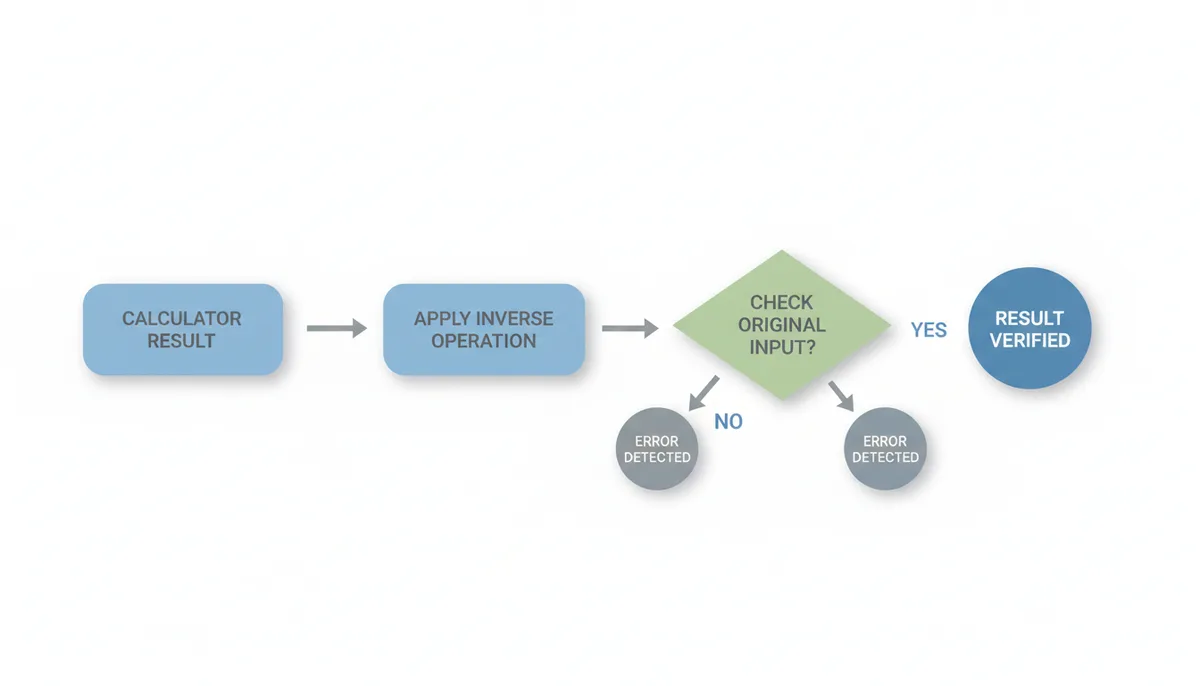
The most mathematically sound way to verify a result is to use the inverse operation. This essentially turns the calculator's output into a new input to see if you land back where you started.
If you have used a division tool, multiply the result by the divisor. If the calculator says $100 / 5 = 20$, immediately check if $20 \times 5 = 100$. If it does, the division is correct. If you used a multiplication tool, divide the result by one of your factors. This is especially useful for complex percentage changes.
For loans, use the "Total Repayment" check. If a loan calculator tells you that your monthly payment for a $30,000 loan over 60 months is $500, perform a quick multiplication: $500 \times 60 = 30,000$. You can immediately see that this result is impossible because it doesn't account for any interest. This tells you that either your interest rate was entered as 0%, or you've made a fundamental error in understanding the output.
The Most Common Errors an Estimate Will Catch
When you use these techniques, you aren't just "doing math." You are looking for specific, recurring human failures. Most errors fall into three categories:
- Misplaced Decimal Point: This is the king of all errors. Entering 5.0% as 50% or $10,000 as $100,000. Because estimation relies on order of magnitude, this is the easiest error to catch. If your estimate is $2,000 and your result is $20,000, the decimal is the culprit.
- Unit Mismatch: This is common in health and loan calculators. Entering a loan term in months (72) when the calculator expects years (6), or entering height in centimeters (180) when the calculator expects inches (71). Estimation catches this because the resulting number will be biologically or financially absurd.
- Input Transposition: This happens when you type "1,520" instead of "1,250." While harder to catch than a decimal error, rounding the numbers before entering them can help. If you round "1,520" to "1,500" and "1,250" to "1,300" for your estimate, you will see if the calculator's result is wildly inconsistent with the $1,500-$based logic.
When 'Close Enough' Isn't Good Enough: The Limits of Estimation
Estimation is a verification tool, not a replacement for calculation. You should never use an estimate to fill out a legal document, a mortgage application, or a medical prescription. The calculator's precise result is the only one that matters for official purposes; your estimate's job is simply to ensure that the person who entered the data didn't make a silly mistake.
There are also technical limits to where estimation works. If you are dealing with non-linear relationships—where a small change in input causes a massive, non-proportional change in output—estimation becomes very difficult. This includes things like complex physics equations, advanced financial derivatives, or compound interest over 50 years. In these cases, a "small" error in your estimate might lead you to believe the calculator is wrong when it is actually being highly precise about a sensitive variable.
Use estimation to catch the "stupid" mistakes. Leave the precision to the machine.
Frequently Asked Questions
What if my estimate is very different from the calculator result, but I can't find an error in my input?
First, double-check your own estimation math. It is very easy to make a mistake while trying to be "quick." If your math is correct and the discrepancy remains, the calculator might be including factors you didn't account for. For example, a mortgage calculator might include property taxes and insurance (PMI) in the monthly total, whereas your simple estimate only accounted for principal and interest.
How accurate should my estimate be? Within 10%? 20%?
The goal is not perfection; it is the "ballpark." For a result of $2,150, an estimate of $2,000 is a massive success. An estimate of $200 or $20,000, however, is a failure because it didn't flag the error. The required accuracy depends on the context: in a grocery trip, 10% is fine; in a high-stakes investment, you might want to be within 5%.
Does this mean online calculators are often wrong?
No. Reputable online calculators, including the professional tools on CalculatorLine.com, use standardized, tested formulas. The "wrong" result is almost always a result of user error—typing the wrong number, selecting the wrong unit, or misinterpreting a field.
Can I use these techniques for things other than financial or health calculations?
Absolutely. The principles of rounding, grouping, and order of magnitude apply to everything from checking a restaurant bill to calculating how much fuel you need for a road trip or adjusting a recipe for more guests. Estimation is a universal skill.
Is there a specific technique that's best for beginners?
Start with rounding and simplifying. It is the most intuitive method and it will catch the vast majority of common mistakes, especially those involving misplaced decimals. Once you are comfortable with that, move on to more advanced methods like the Rule of 72 or inverse operations.
The Mathematics of Error: Why Small Inputs Create Large Gaps
To understand why estimation is a survival skill, you have to understand how errors propagate through a formula. Most people assume that if they are off by 5% on an input, the result will be off by roughly 5%. In simple addition, that is true. But most of the calculators you use—mortgage, investment, or calorie calculators—are built on non-linear functions. In these models, a tiny slip in a single variable can cause the output to explode or collapse.
Consider the relationship between interest rates and time in an investment calculator. This is a power function. If you are calculating the future value of a retirement account, the interest rate is the base and the time is the exponent. A mistake in the interest rate doesn't just add a few dollars to the end; it changes the slope of the entire growth curve. If you enter 7% instead of 0.7% (a common decimal error), you aren't just off by a factor of ten; you are looking at a result that is exponentially larger than reality. This is why a simple "ballpark" check is mandatory. If your estimate says your money should double in 10 years, but the calculator says it will triple in 2, the non-linear nature of the math has amplified your input error into a catastrophic output error.
This is also true for biological calculations like TDEE. The relationship between your weight and your caloric needs is relatively linear, but the relationship between your activity multiplier and your total burn is not. A small error in your estimated body fat percentage can lead to a significant error in your lean muscle mass calculation, which in turn shifts your BMR. When these errors layer on top of each other, you get what mathematicians call error propagation. By using a "sanity check" based on a simplified, linear version of the formula, you create a baseline that is resistant to these compounding distortions. You are essentially checking the "engine" of the formula to make sure it hasn't spun out of control.
A Masterclass in Estimation: The $50,000 Auto Loan Scenario
Let’s move past theory and walk through a high-stakes real-world example. Imagine you are at a dealership or looking at a financing offer online. You see a quote for a $50,000 loan with a 6.5% APR for 72 months. Before you touch a single calculator, you should perform a "back-of-the-envelope" calculation to establish your mental anchor.
Step 1: The Principal/Interest Anchor. A quick way to estimate interest on a medium-term loan is to take the annual interest rate and apply it to the principal. 6.5% of $50,000 is $3,250. This is what you would pay in interest in the first year if the principal didn't move. Since the principal does go down as you pay it off, you know the total interest over 6 years will be significantly less than $3,250 multiplied by 6 ($19,500), but more than $3,250. A safe mental range for total interest on a 6-year loan at this rate is roughly $10,000 to $12,000.
Step 2: The Monthly Payment Anchor. Now, let's estimate the monthly payment. Take that $50,000 and divide it by the number of months: $50,000 / 72. To make this easy, round 72 to 75 or 70. $50,000 / 70 is roughly $715. However, this $715 only covers the principal; it doesn't include interest. We know the interest will add a bit more. If our total interest is roughly $10,000, that adds about $1,400 per year, or about $115 per month. So, $715 + $115 = $830. Your mental target is approximately $830 per month.
Step 3: The Verification. Now, you go to a loan calculator and enter the exact figures: $50,000, 6.5%, 72 months. The calculator gives you $841.80. Because your estimate of $830 was in the same "neighborhood," you can trust the result. If the calculator had spat out $1,200 or $550, you would immediately know that either the APR was entered incorrectly, the term was entered in years instead of months, or the calculator was adding hidden fees you didn't authorize.
Estimation vs. Formal Calculation: When to Invest the Effort
A common question is whether it is worth the mental effort to estimate at all. If you have a smartphone in your pocket, why bother with "back-of-the-envelope" math? The answer lies in the cost of error versus the cost of computation. Estimation is a low-cost, high-leverage activity. It takes thirty seconds of thought and prevents a mistake that could cost thousands of dollars or months of wasted effort.
However, there is a trade-off. Estimation is a "coarse" tool. You should use it to decide if a result is plausible, not to decide on the final value. If you are deciding whether you can afford a mortgage, use the estimate to see if the payment fits your monthly budget. Once you have confirmed the payment is in the right ballpark, you must rely on the precise calculator result for your actual budget spreadsheet. Never build a financial plan around an estimate.
You should also consider the complexity of the task. For simple arithmetic, estimation is overkill. For a single addition or subtraction, just use the tool. But as the number of variables increases—such as calculating a compound interest return with monthly contributions, tax implications, and inflation adjustments—the value of a preliminary estimate skyrockets. In these complex scenarios, the probability of a "fat-finger" error (typing a wrong digit) increases significantly. In these cases, the effort of a 60-second mental check is the best insurance policy you have against the high cost of a precision error.
Edge Cases: Where Estimation Fails
Even the best estimators run into "blind spots" where mental math becomes unreliable. Recognizing these edge cases is just as important as knowing how to round and group.
The first edge case is Extreme Volatility. If you are using a cryptocurrency calculator to convert Bitcoin to Ethereum, the real-time exchange rates are moving every second. An estimate you make at 10:00 AM might be completely invalid by 10:01 AM. In high-volatility markets, estimation shouldn't be used to predict a value, but only to verify that the conversion math itself (the number of decimal places) is sane.
The second is Step-Function Changes. Some financial products have "cliffs." For example, a tax bracket or a loan interest rate might change abruptly at a certain threshold. If your loan amount is right on the edge of a threshold where the interest rate jumps from 5% to 7%, a simple rounding estimate might lead you to believe you are in the 5% bracket, while the calculator correctly places you in the 7% bracket. In these "threshold" scenarios, your estimate will almost always be slightly off, and you should treat the calculator's precise result as the absolute truth.
The third is Highly Granular Units. When dealing with micro-measurements in scientific or specialized health calculations (like calculating the dosage of a medication based on body weight in grams), the margin for error is zero. In these cases, the "order of magnitude" approach is too blunt. If you are off by a factor of ten in a mortgage, you're annoyed; if you are off by a factor of ten in a medical dosage, the consequences are life-threatening. For granular, high-precision requirements, skip the estimation and perform the calculation twice, using two different tools, to ensure they converge on the same number.
Frequently Asked Questions
What if my estimate is very different from the calculator result, but I can't find an error in my input?
First, double-check your own estimation math. It is very easy to make a mistake while trying to be "quick." If your math is correct and the discrepancy remains, the calculator might be including factors you didn't account for. For example, a mortgage calculator might include property taxes and insurance (PMI) in the monthly total, whereas your simple estimate only accounted for principal and interest.
How accurate should my estimate be? Within 10%? 20%?
The goal is not perfection; it is the "ballpark." For a result of $2,150, an estimate of $2,000 is a massive success. An estimate of $200 or $20,000, however, is a failure because it didn't flag the error. The required accuracy depends on the context: in a grocery trip, 10% is fine; in a high-stakes investment, you might want to be within 5%.
Does this mean online calculators are often wrong?
No. Reputable online calculators, including the professional tools on CalculatorLine.com, use standardized, tested formulas. The "wrong" result is almost always a result of user error—typing the wrong number, selecting the wrong unit, or misinterpreting a field.
Can I use these techniques for things other than financial or health calculations?
Absolutely. The principles of rounding, grouping, and order of magnitude apply to everything from checking a restaurant bill to calculating how much fuel you need for a road trip or adjusting a recipe for more guests. Estimation is a universal skill.
Is there a specific technique that's best for beginners?
Start with rounding and simplifying. It is the most intuitive method and it will catch the vast majority of common mistakes, especially those involving misplaced decimals. Once you are comfortable with that, move on to more advanced methods like the Rule of 72 or inverse operations.
Sources
- Consumer Financial Protection Bureau (CFPB) — Definitions and components of a mortgage payment (principal, interest, taxes, insurance) for the financial estimation examples.
- U.S. Securities and Exchange Commission (SEC) — The explanation of the 'Rule of 72' for compound interest, a key estimation tool for investment calculations.
- Centers for Disease Control and Prevention (CDC) — The official definitions, formulas, and healthy ranges for Body Mass Index (BMI), providing a baseline for the health calculator estimation examples.
- National Institute of Standards and Technology (NIST) — Fundamental principles of units and measurement, backing the section on 'Unit Mismatch' as a common source of error.
- Khan Academy — The basic mathematical principles of estimation, rounding, and order of magnitude calculations.